
Quick Answer
Dogs have an incredible sense of smell, possessing around 300 million receptors compared to our mere six million. This means their noses are roughly 50 times more powerful than ours, allowing them to detect tiny traces of scent that are completely invisible to humans. It is truly fascinating because this sensitivity allows dogs to essentially ‘smell time’, tracking the history and movement of people within a room based on how much a scent has faded. Their world is defined by a deep, layered land
In a hurry? TL;DR
- 1Leverage canine olfactory power by training dogs for specialized detection tasks, as their 300 million receptors outperform advanced technology in identifying diseases, explosives, and environmental shifts.
- 2Understand that dogs perceive time through scent decay, allowing them to track movement and determine the history of a room based on lingering odor strength.
- 3Recognize that dogs possess a physical nasal architecture that separates breathing from scent analysis, enabling them to sniff continuously without disrupting their intake of chemical data.
- 4Utilize the canine vomeronasal organ to identify pheromones and chemical signals that remain completely undetectable to human senses and standard man-made sensors.
- 5Acknowledge the extreme sensitivity of dogs, which can distinguish between identical twins by scent, to improve search and rescue or security operations in complex environments.
Why It Matters
Dogs experience the world through a sophisticated fourth dimension of time, using their extraordinary sense of smell to track events long after they have occurred.
Dogs possess roughly 300 million olfactory receptors in their noses, dwarfing the 6 million found in humans. This physiological advantage allows them to detect specific scents at concentrations as low as one part per trillion.
Key Olfactory Statistics
- Olfactory Receptors: 300 million (Dogs) vs 6 million (Humans)
- Brain Allocation: The percentage of a dog’s brain devoted to analysing smells is 40 times larger than a human's.
- Detection Threshold: One part per trillion (equivalent to detecting one drop of liquid in twenty Olympic-sized swimming pools).
- Exhalation Efficiency: Dogs can sniff continuously, inhaling through the nostrils while exhaling through side slits to maintain a constant stream of scent.
Why It Matters
Understanding the canine nose is not just about appreciating pets; it is about acknowledging a biological sensor that outperforms almost every piece of man-made technology in detecting disease, explosives, and ecological changes.
The Architecture of a Super-Sniffer
The disparity between human and canine olfaction begins with physical surface area. If you were to unroll the olfactory epithelium inside a dog’s nose, it would cover a space larger than the dog itself. In contrast, the human equivalent is roughly the size of a postage stamp.
According to researchers at Alexandra Horowitz’s Dog Cognition Lab at Barnard College, dogs do not just smell things; they smell time. Because scents fade at predictable rates, a dog can determine who was in a room recently and which direction they were travelling based on the strength of the lingering scent trail.
Unlike humans, who use the same passage for breathing and smelling, dogs have a fold of tissue that separates the two functions. When a dog inhales, the air divides. One path goes to the lungs, while the other is directed into a recessed area dedicated solely to scent analysis.
The One Part Per Trillion Threshold
To grasp the sensitivity of 300 million receptors, consider a study published in the journal Applied Animal Behaviour Science. Researchers found that dogs could distinguish between identical twins solely by scent, even when the twins lived in the same house and ate the same food.
James Walker, former director of the Sensory Research Institute at Florida State University, compares canine sensitivity to the ability to detect a single rotten apple in two million barrels. This is not merely a quantitative difference in receptor count; it is a qualitative difference in how the brain processes chemical signals.
Practical Applications
The reliability of the canine nose has led to its integration into high-stakes industries where technology often fails.
Detection of Disease: According to Medical Detection Dogs UK, trained bio-detection dogs can identify the scent of certain cancers, Parkinson’s disease, and even malaria with accuracy rates exceeding 90 percent.
Environmental Conservation: Conservation groups use scat-detection dogs to track elusive species like tigers or whales. A dog on the bow of a boat can detect whale faeces from over a mile away, allowing researchers to collect biological data without disturbing the animals.
Search and Rescue: In the aftermath of avalanches, a single dog can search an area that would take 20 humans several hours to cover, detecting human scent trapped under metres of packed snow.
Forensics and Law Enforcement: Bloodhounds are famously used in legal proceedings because their tracking ability is so specialised that their results are often admissible in American courts as forensic evidence.
Interesting Connections
- Noses as Fingerprints: The pattern of ridges and creases on a dog's nose is unique to each individual, much like a human fingerprint.
- Wet Noses: The moisture on a dog’s nose is not just for cooling; it helps trap scent molecules, pulling them into the olfactory system for analysis.
- The Slit Design: The side slits on a dog’s nostrils allow them to expel air without displacing the scent molecules they are trying to inhale.
Do all dog breeds have the same number of receptors?
No. While most dogs average 200 to 300 million, Bloodhounds sit at the top of the hierarchy with approximately 300 million. Brachycephalic breeds, like Pugs, have fewer due to their shortened nasal passages, though they still far outperform humans.
Can dogs smell underwater?
Dogs cannot breathe underwater, but they can detect scents that have risen to the surface. Cadaver dogs are frequently used to locate submerged bodies by sniffing the air just above the water's surface.
Why do dogs lick their noses?
Licking the nose keeps it moist, which is essential for capturing scent particles from the air. It also allows the dog to move those particles toward the Jacobson’s organ for deeper analysis.
Key Takeaways
- Scale: Dogs have up to 50 times more scent receptors than humans.
- Processing: A significant portion of the canine brain is dedicated to olfactory analysis, compared to a tiny fraction in humans.
- Sensitivity: Dogs can detect substances in parts per trillion, a level of precision that remains difficult for modern machinery to replicate.
- Function: The canine nose functions as a temporal tool, allowing dogs to perceive the history of a physical space.
For more on biological wonders, read our guides on why cats always land on their feet, the secret intelligence of crows, or how octopuses think with their arms.
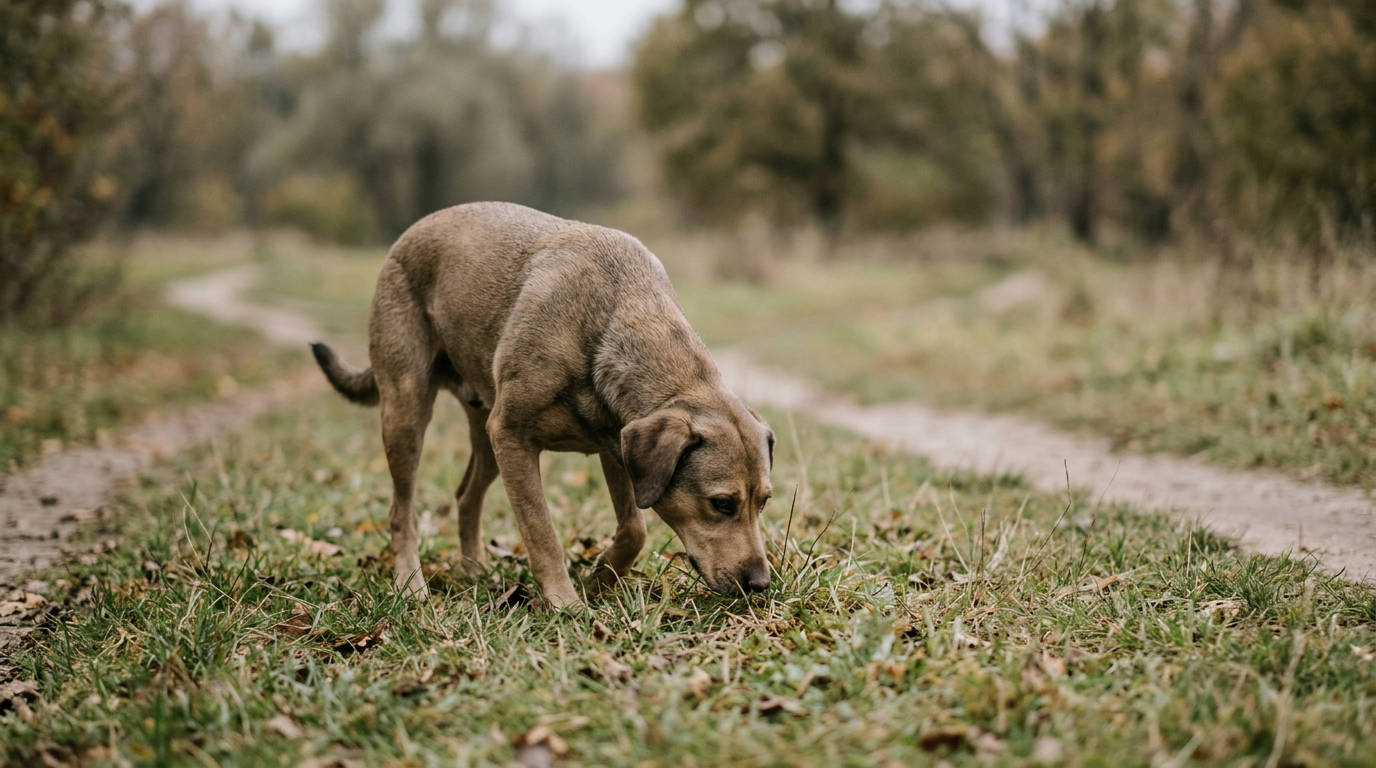
We are living alongside a biological miracle that views the world through a chemical lens we can barely imagine. The next time your dog stops to sniff a nondescript patch of grass, remember: they aren't just looking at the ground; they are reading a detailed history of the neighbourhood.
Frequently Asked Questions
Sources & References
- 1PBSVerifies that dogs have up to 300 million olfactory receptors compared to 6 million in humans, devote 40 times more brain power to scent analysis, and possess sensitivity reaching parts per trillion.pbs.org
 Encyclopaedia BritannicaDetails the anatomy and physiological capacity of canine scent receptors and the division of airflow for breathing versus smelling.britannica.com