
Quick Answer
While humans only refresh a tiny fraction of their lung air with each breath, whales and dolphins can replace up to 90% in one go. This incredible biological feat turns these marine mammals into living oxygen tanks. Because they can exchange their entire lung volume almost instantly, they are perfectly adapted for life beneath the waves. It is a brilliant example of evolutionary efficiency that allows them to remain submerged for extraordinary periods while we are left gasping for our next shall
In a hurry? TL;DR
- 1Humans refresh only 10–15% of lung volume per breath, whereas whales and dolphins optimize gas exchange by replacing up to 90% of their lung capacity in one blow.
- 2Cetaceans possess specialized, flexible rib cages and diaphragms that allow for near-total lung deflation and rapid reinflation without the risk of alveolar collapse common in humans.
- 3Unlike humans who store most oxygen in the lungs, whales store nearly 90% of their oxygen directly in their blood and muscles, significantly extending their dive times.
- 4Whales utilize high concentrations of the protein myoglobin in their muscle tissue, which allows them to effectively store and utilize oxygen during long periods of underwater activity.
- 5Human lungs retain a large volume of 'stale air' to prevent collapse, making us inefficient breathers compared to the extreme, high-pressure adaptation of marine mammals.
Why It Matters
Whales and dolphins have evolved to replace almost all of their lung air in a single breath, making them far more efficient oxygen-users than humans who leave the majority of their lung capacity filled with stale air.
Humans refresh only a tiny fraction of the air in their lungs with a normal breath, whereas marine mammals like whales and dolphins replace nearly 90% of their lung capacity in a single blow. This discrepancy highlights the vast difference between terrestrial survival and the extreme physiological demands of the deep ocean.
The Vital Statistics
- Human air exchange: 10 to 15% per breath
- Cetacean air exchange: 80 to 90% per breath
- Human lung capacity: 6 litres (average adult male)
- Blue whale lung capacity: 5,000 litres
- Survival time: Humans (minutes); Sperm whales (up to 90 minutes)
Why It Matters
This efficiency gap reveals that humans are essentially shallow breathers by design, while whales have evolved into living oxygen tanks capable of surviving pressures that would crush a land-dweller.
The Mechanics of the Blowhole
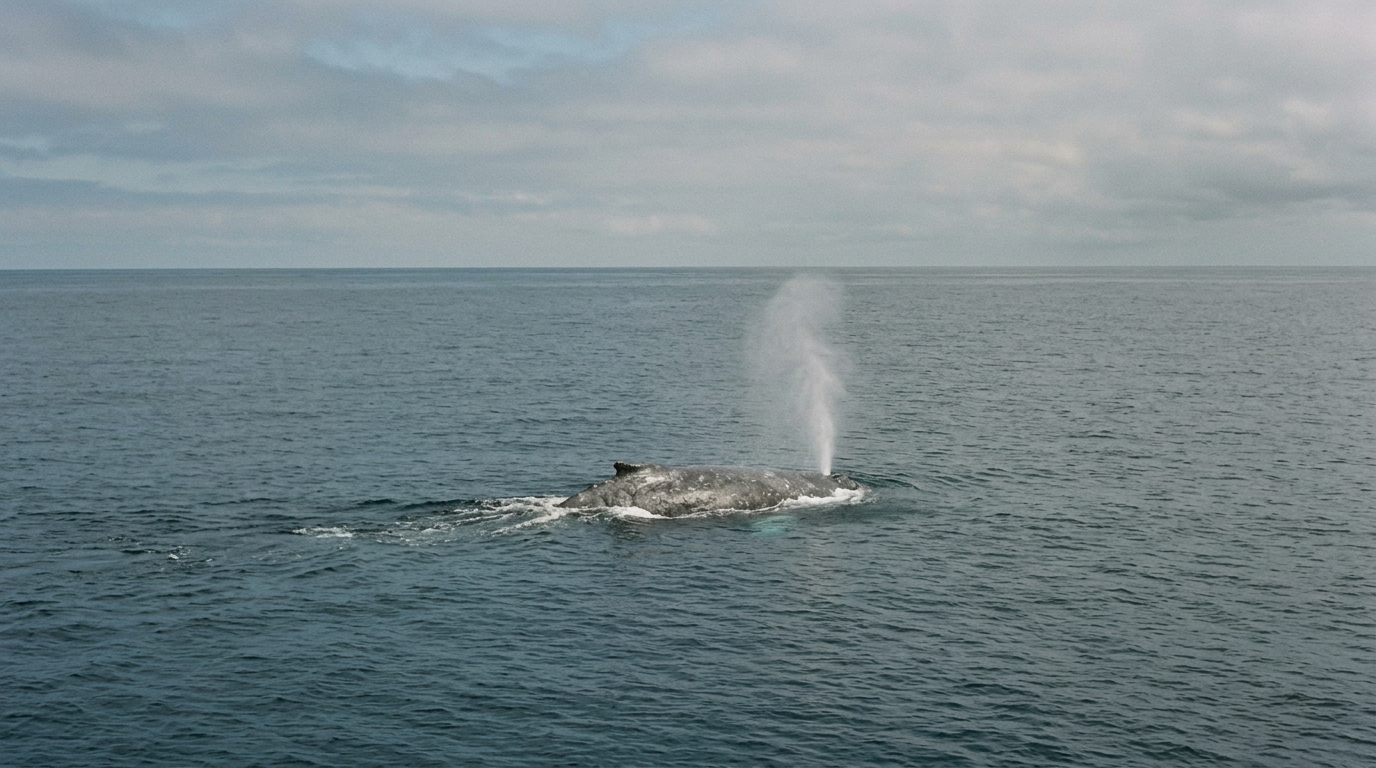
When a whale surfaces, the explosive spray from its blowhole is the sound of an ultra-efficient gas exchange. Unlike humans, who carry around a large volume of stale air, whales have evolved to purge their lungs almost entirely.
This stale air, known as residual volume, remains in human lungs to prevent the delicate alveoli from collapsing. In contrast, researchers at the Woods Hole Oceanographic Institution have observed that cetaceans possess highly specialised diaphragms and rib cages that allow the lungs to collapse safely and reinflate rapidly.
The Efficiency Gap
Humans are remarkably wasteful breathers. Even when we take a deep breath, we rarely cycle through more than 70% of our lung volume. In a resting state, we are merely sipping at the atmosphere.
Whales and dolphins cannot afford such luxury. Because they spend the vast majority of their lives underwater, they must maximise every second spent at the surface. According to data published in the Journal of Experimental Biology, this 90% exchange rate allows them to saturate their blood and muscle tissue with oxygen far more effectively than any land animal.
The Myoglobin Advantage
The secret to the whale’s endurance isn't just the breath itself, but what happens to the oxygen once it enters the body. While humans rely heavily on haemoglobin in the blood, whales possess massive concentrations of myoglobin in their muscle tissue.
This protein stores oxygen for use during long dives. In some species, the concentration of myoglobin is so high that their muscle meat appears almost black. This prevents the animal from suffering from hypoxia even when their lungs are empty of air.
Why Humans Don't Breathe Like Whales
If 90% air exchange is so efficient, why haven't humans evolved to do the same? The answer lies in our environment.
On land, oxygen is constant and easily accessible. We do not need to store it because we can breathe twelve to twenty times per minute. The residual air in our lungs acts as a buffer, ensuring that the blood-gas exchange remains stable between breaths. If we emptied our lungs as violently as a dolphin, the energy cost would outweigh the benefits.
Practical Applications and Scenarios
- Free-diving: Elite human divers practice packing their lungs to mimic cetacean efficiency, though they can never match the involuntary physiological response of a dolphin.
- Medical Ventilators: Understanding how whales manage high-pressure gas exchange informs respiratory therapy for patients with collapsed lungs (atelectasis).
- Environmental Monitoring: Scientists now collect the blow from whales using drones (SnotBots) to analyse DNA and hormone levels, a non-invasive method made possible by the sheer volume of their exhalations.
Interesting Connections
- Etymology: The word dolphin comes from the Greek delphys, meaning womb, perhaps a nod to their status as mammals in a world of fish.
- Cultural Reference: In Moby Dick, Herman Melville describes the whale's breath as a fountain of mist, correctly noting that it is a sign of the animal's powerful vitality.
- Evolution: Whales are descendants of land-dwelling hoofed mammals; they returned to the sea roughly 50 million years ago, trading their legs for fins and their shallow breathing for deep-sea endurance.
Do whales ever get the bends?
Generally no, because they collapse their lungs to prevent nitrogen absorption. However, if they are startled and surface too quickly—often due to sonar interference—they can suffer from decompression sickness.
Can humans train to increase their air exchange?
Yes, through pranayama or athletic training, humans can increase their vital capacity, but the structural 15% residual volume limit remains a biological fixture to prevent lung collapse.
Is the spray from a blowhole just water?
No, it is mostly warm, pressurised air and surfactant-rich mucus. The water you see is often just the small amount sitting on top of the blowhole when it opens.
Key Takeaways
- Humans are shallow breathers: We only cycle 10 to 15% of our lung capacity per breath.
- Marine mammals are high-efficiency breathers: They exchange up to 90% of their air.
- Residual volume: Humans need leftover air to keep lungs open; whales can safely collapse theirs.
- Myoglobin: Whales store oxygen in their muscles, not just their lungs, allowing for hour-long dives.
- Environment dictates biology: Our breathing is lazy because oxygen is everywhere; a whale’s breath is urgent because oxygen is a finite resource.
While you read this, you likely took a breath that replaced just a tenth of your air. A dolphin, in that same moment, could have completely refreshed its entire system.
Frequently Asked Questions
Sources & References
 Encyclopaedia BritannicaExplains the respiratory adaptations of cetaceans, including their high lung-exchange efficiency compared to terrestrial mammals and physiological mechanisms for deep diving.britannica.com
 WikipediaDetails diving adaptations in marine mammals, noting that they renew up to 90% of the air in their lungs with each breath compared to 10–20% for humans.en.wikipedia.org
- WikipediaDocuments how deep-diving cetaceans possess exceptionally high concentrations of myoglobin in their muscle tissue to store large reserves of oxygen during long submerged periods.en.wikipedia.org