
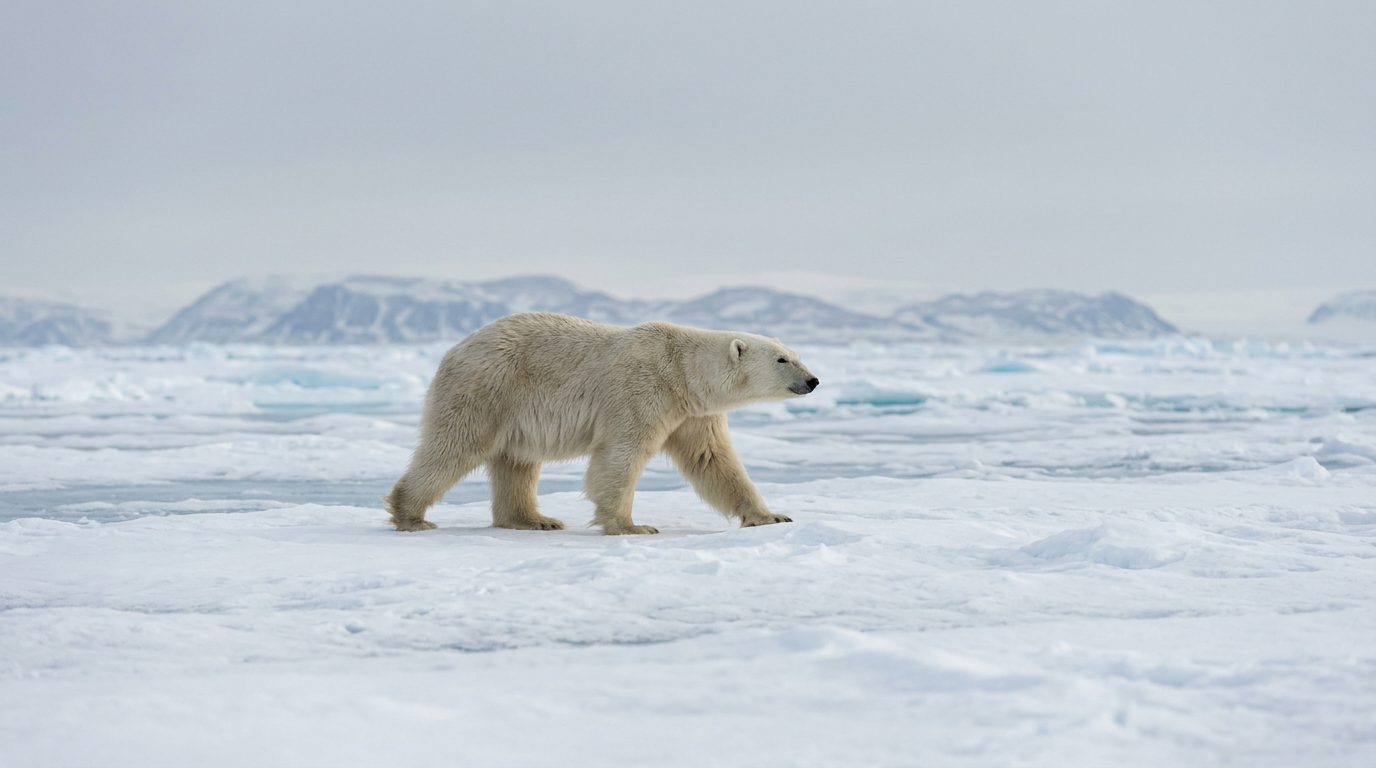
Quick Answer
Polar bears are not actually white; they have black skin and clear, hollow hairs that scatter light to create the appearance of white fur. This is a brilliant evolutionary trick. While the outer coat helps them blend into the snowy landscape, their dark skin acts like a solar panel, absorbing and retaining as much precious warmth as possible from the sun. It is a perfect example of nature balancing effective camouflage with the urgent need to survive in a freezing arctic environment.
In a hurry? TL;DR
- 1Understand that polar bears lack white pigment; their fur consists of hollow, transparent keratin tubes that reflect and scatter light to create an optical illusion of whiteness.
- 2Recognize the mechanism of Mie scattering, where hollow hair structures bounce light in all directions, causing the bear to appear white to the human eye.
- 3Note that a polar bear's skin is actually pitch black, a vital evolutionary adaptation that maximizes solar heat absorption to help the animal survive extreme Arctic temperatures.
- 4View the polar bear as a biological solar panel, where its translucent fur acts as a conduit, delivering solar radiation directly to its heat-absorptive black skin.
- 5Appreciate how the polar bear’s unique anatomy simultaneously provides effective camouflage in snowy environments while significantly improving its thermal retention through sophisticated optical physics.
- 6Observe that polar bears can occasionally turn green in warm, humid zoo environments because algae can colonize their hollow, transparent hairs under specific, non-Arctic climate conditions.
Why It Matters
Polar bears are a fascinating example of evolutionary engineering, using transparent fur to manipulate light for camouflage while relying on their hidden black skin to soak up essential solar heat.
The polar bear is a master of biological deception, sporting pitch-black skin and transparent, pigment-free fur that only appears white due to the way it scatters visible light. This evolutionary trick allows the Arctic’s apex predator to remain camouflaged in the snow while simultaneously absorbing maximum heat from the sun.
- Skin Colour: Jet black
- Hair Structure: Hollow, pigment-free, and translucent
- Light Effect: Luminescence via Mie scattering
- Heat Retention: High-efficiency solar absorption through the epidermis
- Scientific Term: Structural coloration
Why It Matters
Nature rarely chooses the simple path when survival is at stake. By ditching white pigment in favour of transparent, hollow tubes, the polar bear solves two problems at once: it disappears into the blinding Arctic landscape and stays warm in sub-zero temperatures by piping solar energy directly to its black skin.
The Optical Illusion of the North
We perceive polar bears as white for the same reason we see clouds or snow as white. According to research from the University of California, Riverside, the hairs of a polar bear are actually hollow tubes made of keratin. Because these tubes lack any pigment, they do not absorb light; instead, they reflect and scatter it in every direction.
This phenomenon, known as Mie scattering, happens when the wavelength of light is similar to the diameter of the particles or structures it hits. In the polar bear’s case, the light bounces around inside the hollow hair shafts and off the irregular internal surfaces. By the time that light reaches our eyes, all wavelengths are reflected back equally, creating the visual sensation of pure white.
The Solar Collector Underneath
While the fur handles the camouflage, the skin handles the thermodynamics. If you were to shave a polar bear, you would find a creature as dark as a grizzly. This black skin is an evolutionary necessity. Because black surfaces absorb all wavelengths of light, they are far more efficient at converting solar radiation into heat than white surfaces would be.
Research published in the journal Nature Communications suggests that this setup is remarkably efficient. The hollow hairs don’t just scatter light; they act as a greenhouse layer. They trap a pocket of warm air next to the skin, while the dark epidermis drinks in whatever UV radiation penetrates the coat. Unlike other Arctic animals that rely purely on thick blubber, the polar bear uses this sophisticated optical physics to supplement its caloric energy.
The Green Bear Phenomenon
One of the most striking proofs of the fur’s transparency occurred at the San Diego Zoo in the late 1970s and again in Singapore in 2004. In warmer, more humid climates, polar bears have been known to turn a distinct shade of green.
This happens because the hollow core of each hair provides a perfect, protected environment for algae to grow. In the wild Arctic, it is too cold for algae to survive, but in temperate zoo enclosures, the microscopic plants colonise the hair shafts. Because the hair is clear, the green pigment of the algae shines through, proving that no white pigment exists to mask it.
Practical Applications and Observations
- Wildlife Photography: Photographers must often overexpose their shots because the light scattering from the fur can trick camera sensors into underexposing the dark surroundings.
- Military Tech: Engineers have studied the structure of polar bear hair to develop new types of thermal insulation and infrared-shielding materials for stealth technology.
- Climate Monitoring: Because the fur relies on light scattering, scientists can use specialized sensors to track bear health, as changes in hair structure can indicate nutritional stress.
Interesting Connections
- Snow and Ice: Snow appears white for the exact same reason as polar bear fur; it is composed of translucent crystals that scatter light.
- Blue Eyes: Human blue eyes contain no blue pigment. The colour is the result of Tyndall scattering within the stroma, similar to the Mie scattering in bear fur.
- The Penguin Paradox: While polar bears use black skin for heat, penguins use black feathers on their backs for the same reason, but they rely on dense pigment rather than structural transparency.
Why don’t polar bears look black if their skin is black?
The density of the fur is so high that light is scattered long before it hits the skin. The white light reflected back to our eyes completely masks the dark surface underneath.
Do polar bears ever get sunburned?
Despite their black skin, polar bears are protected by their thick fur, which scatters and absorbs the majority of harmful UV rays before they can cause damage to the epidermis.
Can their fur turn yellow?
Yes. As polar bears age or consume high-fat diets, oils from their prey can stain the hollow hairs, giving the coat a yellowish tint that is especially visible against pure white snow.
Key Takeaways
- Transparent Physics: Polar bear hair contains no pigment; it is clear and hollow.
- Light Scattering: The white appearance is an optical illusion caused by light bouncing off the internal structure of the hair.
- Heat Absorption: Underneath the coat, the bear’s skin is jet black to better absorb solar heat.
- Evolutionary Efficiency: This combination provides both high-level camouflage and vital thermal regulation in the Arctic.
Frequently Asked Questions
Sources & References
- 1Poor Richard's AlmanackExplains that polar bear fur consists of pigment-free, hollow, translucent hairs that scatter light to appear white, covering black skin that absorbs heat.loc.gov
 Encyclopaedia BritannicaDocuments the physical characteristics of polar bears, including their dense, hollow guard hairs and underlying black skin that functions in thermal regulation.britannica.com