
Quick Answer
New Caledonian crows possess an intelligence comparable to a five-to-seven-year-old child, allowing them to solve complex puzzles, craft tools, and recognise specific human faces for years. This is truly remarkable because it demonstrates that sophisticated reasoning and problem-solving skills can evolve in bird brains that are structurally entirely different from those found in mammals. It challenges our traditional understanding of cognition, proving that high-level intelligence does not rely
In a hurry? TL;DR
- 1New Caledonian crows demonstrate cognitive abilities comparable to human children aged five to seven, proving that complex reasoning exists outside of mammalian brain structures.
- 2Researchers confirmed these birds solve advanced water-displacement puzzles by selecting effective, weighted objects, showcasing an understanding of causal relationships rather than trial and error.
- 3These crows are the only non-primate species that actively manufacture and refine tools, such as crafting hooked sticks to extract food from deep crevices.
- 4Tool-making behaviors are passed down through generations, indicating that these crows utilize cultural transmission to teach young birds sophisticated engineering techniques.
- 5Crows possess remarkable social memory and can identify and remember specific human faces for over five years, allowing them to distinguish between threatening and neutral individuals.
- 6The advanced intelligence of corvids demonstrates that nature has evolved sophisticated cognitive systems in non-layered brains, challenging traditional definitions of complex problem-solving and intelligence.
Why It Matters
It is genuinely fascinating that these birds possess the problem-solving skills of a young child, proving that high-level intelligence can evolve in brain structures entirely different from our own.
New Caledonian crows possess cognitive abilities comparable to a seven-year-old human, demonstrating the capacity to solve complex water-displacement puzzles, manufacture tools, and recognise specific human faces for years.
Key Facts and Figures
- Comparative Intelligence: Equivalent to a 5-7 year old human child
- Tool Use: Only non-primate species known to manufacture hooked tools
- Memory Span: Can recall individual human faces for over five years
- Brain-to-Body Ratio: Comparable to great apes and cetaceans
- Test Accuracy: Completed the Aesop’s Fable paradigm with 90 percent success rates
Why It Matters
Understanding corvid intelligence shatters the mammalian monopoly on complex thought, proving that high-level reasoning can evolve in entirely different brain structures.
The Water-Displacement Breakthrough
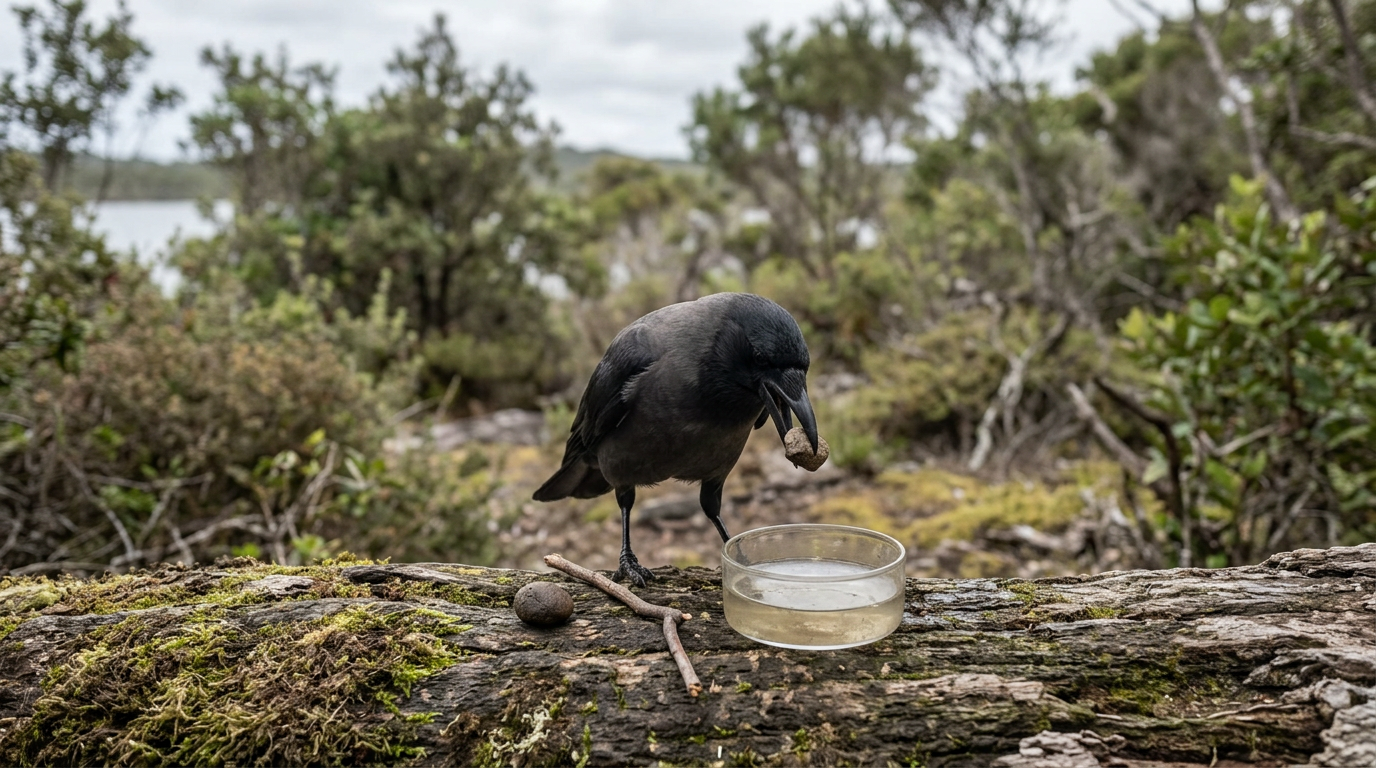
In 2014, researchers at the University of Auckland subjected New Caledonian crows to the Aesop’s Fable test. This experiment required the birds to drop stones into tubes filled with water to raise the level and reach a floating piece of meat.
The results, published in PLOS ONE, revealed that the crows were not merely acting on instinct. They consistently chose heavy objects over light ones, solid objects over hollow ones, and understood that dropping items into a water-filled tube would work, whereas a sand-filled tube would not.
Unlike other animals that rely on trial and error, these crows visualised the solution before acting. They demonstrated a grasp of causal relationships that most children do not master until they reach primary school.
Engineering in the Wild
New Caledonian crows are the only known species besides humans and chimpanzees to create hooked tools. While many animals use found objects, these birds actively refine materials.
They harvest twigs from the Pandanus tree, stripping leaves and sculpting the ends into precise hooks to extract grubs from deep crevices. This behaviour is not purely genetic; young crows learn the craft by observing their elders, indicating a form of cultural transmission.
The Grudge That Never Dies
Crows possess a social memory that rivals primates. A study conducted by John Marzluff at the University of Washington found that crows could identify the face of a specific human who had previously trapped them.
Researchers wore a distinctive caveman mask while capturing and tagging birds. Years later, the crows continued to scold and mob anyone wearing that specific mask, while ignoring neutral masks.
Even more startling, crows that were never captured also began mobbing the caveman. The original birds had communicated the threat to their peers and offspring, creating a multi-generational social record of a specific enemy.
Practical Applications and Scenarios
- Urban Problem Solving: Crows in Japan have been observed placing walnuts in front of stationary cars at traffic lights, waiting for the vehicles to crush the shells, and then collecting the food when the light turns red.
- Facial Recognition: Wildlife researchers must now use masks or disguises when handling crows to avoid being harassed by the local population during future field sessions.
- Environmental Indicators: Monitoring corvid behaviour provides insights into how wildlife adapts to rapid urbanisation through cognitive flexibility rather than physical evolution.
Interesting Connections
- Etymology: The collective noun for crows is a murder, a term likely derived from folk tales regarding their supposed tendency to hold trials for members of their group.
- Mythology: In Norse mythology, Odin was accompanied by two ravens, Huginn and Muninn, representing Thought and Memory, a poetic intuition of their actual cognitive strengths.
- Neurology: While mammals use the neocortex for high-level thinking, birds use the nidopallium, proving that intelligence is not dependent on a specific brain architecture.
Which bird is the smartest?
New Caledonian crows and African Grey parrots are generally considered the most intelligent, though ravens show similar problem-solving skills in social contexts.
Can crows talk like parrots?
Yes, crows and ravens can mimic human speech and environmental sounds, often using these vocalizations to trick other animals or communicate within their group.
Do crows really hold funerals?
Crows gather around their dead, but research suggests this is an information-gathering exercise to assess potential threats in the area rather than a mourning ritual.
Key Takeaways
- Cognitive Parity: New Caledonian crows solve physics-based puzzles at the level of a young child.
- Social Learning: They pass down tool-making techniques and information about dangerous humans through generations.
- Dense Architecture: Their intelligence is powered by extreme neuronal density rather than brain size.
- Intentionality: Their actions show evidence of pre-planning and an understanding of cause and effect.
Crows are not just mimics or scavengers; they are feathered engineers with long memories and a sharp eye for who exactly is walking through their territory.
Frequently Asked Questions
Sources & References
- 1PLOS BiologyDetails the 2014 study testing New Caledonian crows on the Aesop's Fable water-displacement task, demonstrating causal reasoning comparable to 5- to 7-year-old children.journals.plos.org
 WikipediaProvides an overview of the New Caledonian crow's complex tool manufacture, cognitive testing performance, and problem-solving abilities.en.wikipedia.org