
Quick Answer
The Berlin Wall fell largely because of a clumsy bureaucratic blunder. During a live press conference on 9 November 1989, a government official incorrectly announced that travel restrictions were being lifted with immediate effect. This small mistake triggered a massive, joyful rush to the border that the guards were powerless to stop. It remains a fascinating historical irony that one of the twentieth century’s most monumental shifts was not the result of a grand master plan, but simply a poorl
In a hurry? TL;DR
- 1Recognize that administrative errors and communication failures can trigger massive geopolitical shifts, proving that history is often shaped by small, human mistakes rather than just grand strategies.
- 2Ensure all team members responsible for public statements are thoroughly briefed, as misinformation or misspoken words can have immediate, uncontrollable consequences in high-stakes environments.
- 3Understand that when official information is ambiguous or contradictory, public perception and media amplification will quickly dictate the momentum and actual outcome of the situation.
- 4Maintain clear internal communication channels so that frontline staff have precise instructions during crises, preventing the need for them to make high-risk, unilateral decisions under pressure.
- 5Prepare for the reality that when rigid systems face a sudden vacuum of command, individual leaders may deviate from protocol to prevent violence and maintain order.
- 6Monitor the impact of news coverage, as rapid information dissemination can turn a localized administrative blunder into a global event that forces authorities to capitulate.
Why It Matters
It is fascinating that one of the most significant moments in modern history was triggered by a government official’s simple failure to read his briefing notes.
The Berlin Wall did not fall because of a grand strategic decree or a signed treaty. It fell because Gunter Schabowski, a mid-level East German official, fumbled his notes during a live press conference on 9 November 1989.
- Date: 9 November 1989
- Key Figure: Gunter Schabowski
- Mistake: Claimed travel restrictions were lifted immediately
- Outcome: Thousands rushed the checkpoints, forcing guards to open the gates
- Legacy: The accidental end of the Cold War in Europe
Why It Matters: This event proves that the trajectory of global superpowers can be redirected by a single person failing to read their briefing notes properly.
The Press Conference That Changed Everything
In late 1989, the East German government was desperate. Protests were swelling, and citizens were fleeing to the West via Hungary and Czechoslovakia. To stem the bleeding, the Politburo drafted a new law to allow permanent relocation with proper visas, hoping to release the pressure slowly.
Gunter Schabowski, the government spokesman, had not attended the full briefing on the new regulations. He was handed a piece of paper shortly before walking in front of international cameras. When a journalist asked when the new travel rules would take effect, Schabowski shuffled his papers, looked confused, and uttered the most consequential mistake in modern history.
He told the room the rules applied immediately, without delay.
The Confusion at Checkpoint Charlie
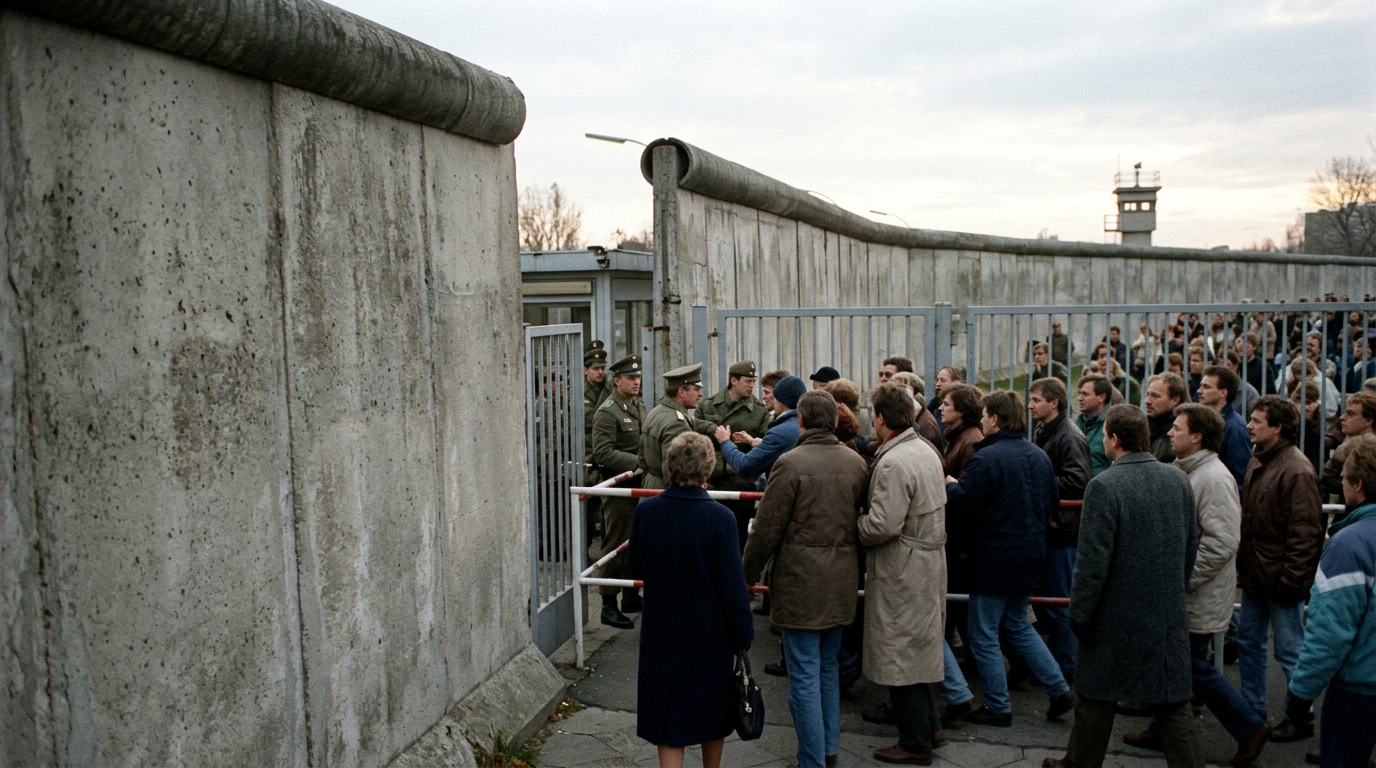
The news hit the airwaves instantly. West Berlin television reported that the borders were open, which East Berliners could see from their own living rooms. Within an hour, thousands of people gathered at the Bornholmer Strasse border crossing.
The border guards had received no orders. They called their superiors, who also had no information. As the crowd grew from hundreds to thousands, the atmosphere shifted from curiosity to a demand for passage. Harald Jager, the officer in charge at Bornholmer Strasse, faced a choice: use lethal force against a peaceful crowd or ignore his standing orders.
Unlike other moments of Soviet-era tension, the lack of communication from the top created a vacuum. Jager eventually ordered his men to open the gates and stop checking passports. The dam had broken.
Why the Accident Worked
The fall of the wall was the result of a communication breakdown at every level of the German Democratic Republic.
- Administrative Error: The decree was supposed to be announced the following morning to allow border guards time to prepare.
- Verbal Slip: Schabowski used the phrase "sofort, unverzuglich" (immediately, without delay).
- Media Amplification: The headlines in the West forced the hand of the East German authorities, who could not retract the statement without sparking a riot.
Compared to the fall of the Bastille or the Bolshevik Revolution, the end of the Berlin Wall was remarkably bloodless, largely because the state was too confused to react.
Practical Implications of the Blunder
The immediate consequence was the reunification of Germany within a year. More broadly, it demonstrated the fragility of authoritarian systems. When the central command fails to communicate, the entire structure can vanish in a single evening.
- Bureaucratic Lessons: High-stakes announcements require dry runs and synchronized timelines.
- Power of Media: The speed of information in 1989 meant a mistake in East Berlin was a reality in West Berlin three minutes later.
- Individual Agency: A single guard’s refusal to shoot changed the map of Europe.
Interesting Connections
The term Mauerspecht (wall woodpecker) refers to the thousands of people who brought hammers and chisels to the wall that night to chip away souvenirs.
The wall was not just a fence; it was a 155-kilometre double-walled fortification with a death strip in the middle. The fact that it was conquered by a clerical error rather than an army remains a source of historical irony.
Why didn't the guards just shoot?
The sheer volume of people made violence impossible without a massacre. Without clear orders from the Politburo, officers like Harald Jager decided that the lives of the citizens were more important than a defunct border policy.
Did Schabowski get in trouble?
He was expelled from the party shortly after, though his mistake effectively ended the party's relevance anyway. In later years, he expressed a sense of peace about his role in the accidental liberation.
Was the wall demolished that night?
No, the physical demolition took months. On the night of 9 November, the wall simply became irrelevant as people climbed over it and walked through the gates.
Key Takeaways
- Human Error: A poorly timed announcement caused a geopolitical collapse.
- No Orders: The lack of instructions to border guards prevented a violent crackdown.
- Peaceful Transition: The accident ensured the wall fell without a single shot being fired.
- Rapid Change: Geopolitical boundaries that seem permanent can dissolve in hours due to simple mismanagement.
Frequently Asked Questions
Sources & References
 Encyclopaedia BritannicaDetails the fall of the Berlin Wall on November 9, 1989, following Günter Schabowski's mistaken press conference announcement that travel restrictions were lifted immediately.britannica.com
 WikipediaDocuments the timeline of November 9, 1989, including the press conference blunder, the media reaction, and Harald Jäger opening the Bornholmer Straße border crossing.en.wikipedia.org