
Quick Answer
The shiny and dull sides of aluminium foil are purely a result of the manufacturing process, not performance. To stop the metal from tearing while being thinned, it is passed through rollers in two layers; the sides touching the rollers become shiny, while the inner sides remain dull. This means there is no functional difference between them. Whether you are roasting a chicken or wrapping up leftovers, feel free to use either side. It is one of those classic kitchen myths that simply isn’t true.
In a hurry? TL;DR
- 1Stop worrying about which side of the foil faces your food; the shiny and dull sides perform identically for all standard cooking and storage tasks.
- 2Understand that the two-tone appearance is a mechanical byproduct of 'doubling,' where two sheets are rolled simultaneously to prevent the delicate metal from tearing.
- 3Recognize that the shiny side is simply the surface that contacted the polished steel rollers, while the matte side touched the other layer of foil.
- 4Ignore myths about heat reflection, as the difference in infrared heat absorption between the two sides is negligible for standard domestic cooking temperatures.
- 5Prioritize convenience when wrapping food, as thermal conductivity remains consistent regardless of which side you choose to face inward or outward.
- 6Note that standard household foil is mostly aluminium with small traces of iron and silicon, making it safe and effective for high-heat oven use.
Why It Matters
The distinct appearance of aluminium foil is merely a functional byproduct of rolling two layers together to prevent tearing, meaning the two sides are functionally identical for all your kitchen needs.
The dull and shiny sides of aluminium foil are a result of a manufacturing process called doubling, where two layers are rolled through a mill at once to prevent tearing. Despite persistent kitchen myths, both sides perform identically for almost all cooking and storage tasks.
The Dual-Texture Mystery
The difference between the two sides of your foil roll has nothing to do with heat reflection or non-stick properties. It is a purely mechanical byproduct of the way the metal is thinned.
According to Reynolds Consumer Products, the largest manufacturer of foil in North America, the two-tone appearance is an unavoidable consequence of the final rolling pass. To reach the extreme thinness required for household use, two sheets of foil are layered together and passed through the heavy rollers of a cold rolling mill simultaneously.
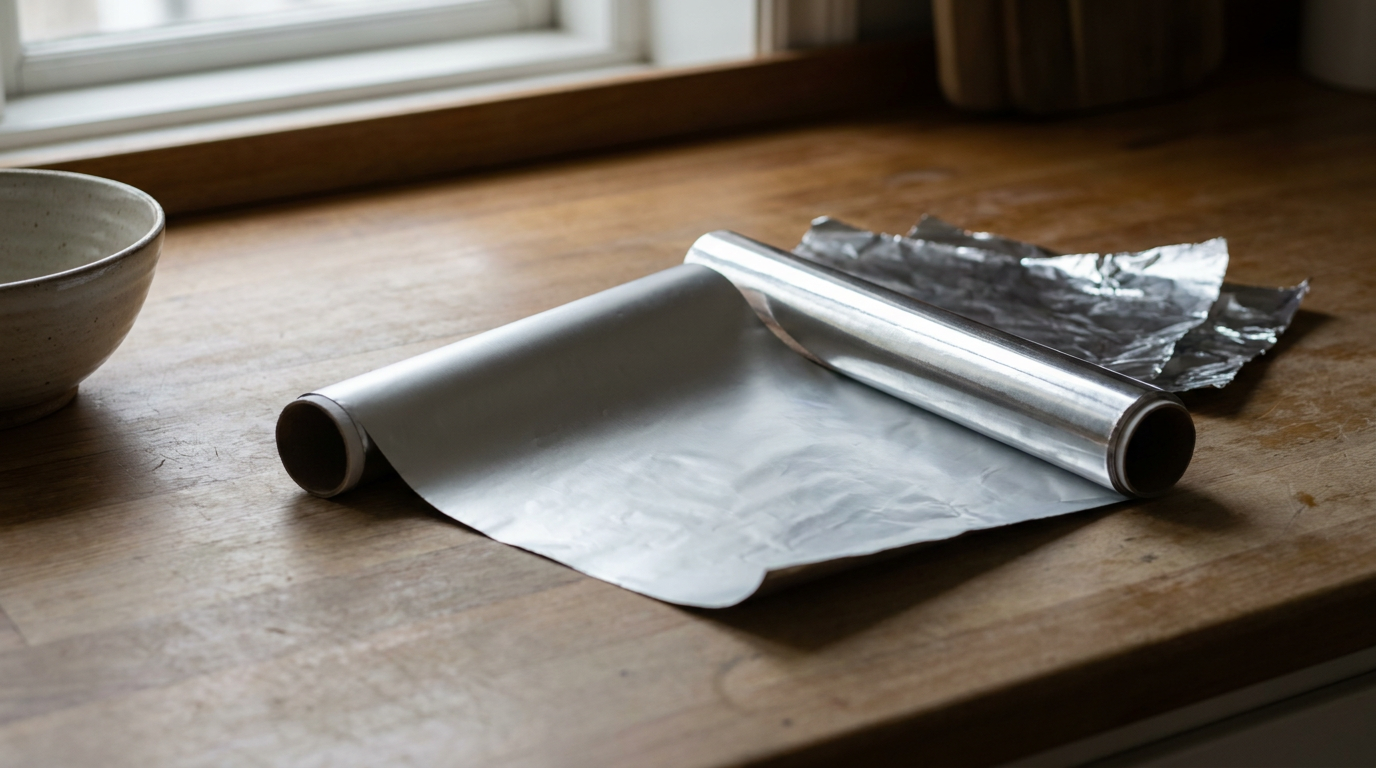
The sides that come into contact with the polished steel rollers emerge with a mirror-like sheen. The sides that face each other inside the sandwich emerge with a matte, dull finish because they are only pressing against another layer of metal rather than the smooth rollers.
Key Facts and Technical Specs
- Material composition: Typically 98.5 percent aluminium, with traces of iron and silicon for strength.
- Standard thickness: Approximately 0.016 mm for standard household foil.
- Melting point: Roughly 660 degrees Celsius.
- Manufacturing method: Cold rolling (the metal is squeezed at room temperature).
- Heat performance: Emissivity is virtually identical on both sides.
The Science of the Roll
The process of thinning aluminium requires immense pressure. When the foil reaches its final stage, it is so delicate that a single sheet would likely tear under the tension of the heavy industrial rollers.
By milling two sheets at once, manufacturers increase the total thickness of the material moving through the machine, which provides enough structural integrity to prevent snapping. Once the process is complete, the two sheets are pulled apart and wound onto individual rolls.
Does Side Choice Affect Your Food?
For 99 percent of kitchen applications, it makes no difference which side faces out. Whether you are wrapping a potato for roasting or covering a tray of leftovers, the thermal conductivity of the thin metal remains the same.
A common misconception suggests the shiny side reflects more heat back into the food. While the shiny side is technically more reflective of visible light, the difference in infrared heat absorption is negligible. In a standard domestic oven, heat is transferred primarily through convection (hot air) rather than radiation.
When the Side Actually Matters
There is one specific exception to the rule: non-stick foil. Products specifically marketed as non-stick have a food-grade silicone coating applied to one side only.
In these cases, the manufacturer usually identifies the non-stick side with a printed label or a noticeably flatter matte finish. If you are using standard, multipurpose foil, you can ignore the aesthetic difference entirely.
Unlike other kitchen tools where orientation is critical, such as serrated knives or carbon steel pans, foil is a rare example of a symmetrical utility despite its asymmetrical appearance.
Which side should I use for roasting?
Either side. The heat transfer rate is identical, and your cooking times will not change based on which side faces the heat.
Does the dull side keep food colder?
No. For refrigerated storage, the foil acts primarily as a barrier against oxygen and light. Both sides perform this function equally well.
Why does some foil have a non-stick side?
Speciality foils have a coating applied to the matte side to prevent delicate items like fish or cheesy toppings from adhering to the metal.
Is aluminium foil safe for acidic foods?
While the side does not matter, the food does. Very acidic ingredients like tomatoes or lemons can react with the metal, causing pinholes to form and leaving a metallic taste.
Key Takeaways
- Texture is a result of two sheets being rolled together (doubling).
- The shiny side touches the steel rollers; the dull side touches the other foil sheet.
- Thermal performance is identical for both sides in a standard oven.
- Orientation only matters if you are using specially coated non-stick foil.
- Standard foil is 100 percent recyclable if it is free of food residue.
Frequently Asked Questions
Sources & References
 WikipediaBackground and contexten.wikipedia.org
 Scientific AmericanScientific research and analysisscientificamerican.com
 BBCReporting and verificationbbc.co.uk
- WikipediaExplains how the doubling manufacturing process creates shiny and dull sides and notes that side orientation has no significant thermal effect in cooking.en.wikipedia.org