
Quick Answer
Scientists have discovered that rats can master the game of hide-and-seek, learning to both conceal themselves and seek out human partners. What makes this truly remarkable is that they played for the sheer joy of it, rather than for a food reward. They even emitted ultrasonic chirps, which researchers interpret as a form of laughter. This suggests that complex, playful behaviour isn't exclusive to humans or primates, offering a fascinating glimpse into the emotional lives of these clever, socia
In a hurry? TL;DR
- 1Use social interaction and play instead of food rewards to increase engagement and motivation when studying or interacting with intelligent animal subjects like rats.
- 2Observe ultrasonic vocalisations and physical displays, such as joy-jumps, to accurately measure and interpret positive emotional states in animals during experimental or training scenarios.
- 3Recognize that rats demonstrate advanced cognitive abilities by mastering complex social roles, situational awareness, and tactical planning without requiring extrinsic caloric incentives.
- 4Leverage the prefrontal cortex's role in social cognition research to better understand how mammals, including humans, process and adhere to complex social rules and games.
- 5Acknowledge that animal play is a sophisticated evolutionary trait, as evidenced by rats' ability to actively prolong games by teasing researchers and strategizing hiding locations.
Why It Matters
It is fascinating that rats can grasp the complex social rules of hide-and-seek and clearly derive joy from the game without the need for food rewards.
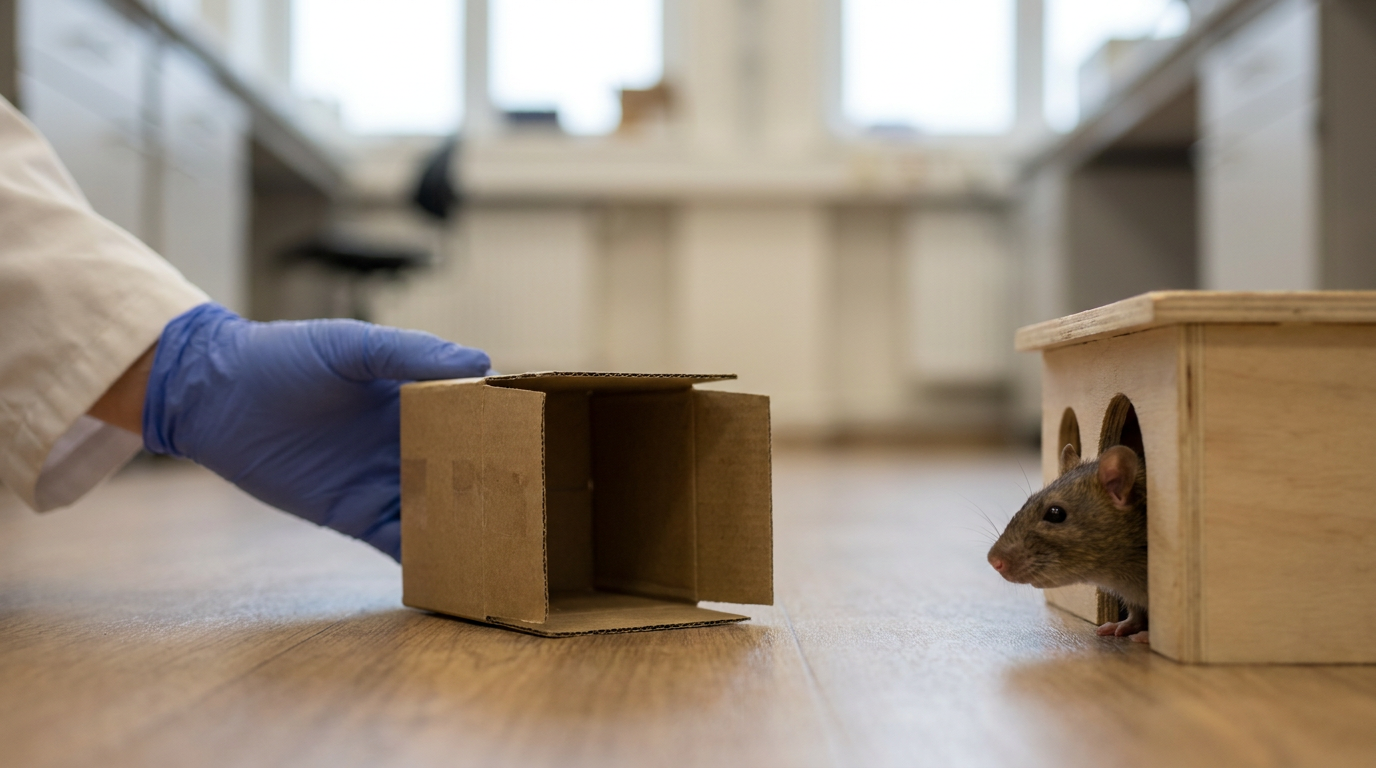
Scientists at the Humboldt University of Berlin successfully taught adolescent rats to play a sophisticated version of hide-and-seek with humans. The research revealed that these rodents not only mastered the rules of the game but also displayed genuine signs of joy, such as giggling in ultrasonic frequencies and performing joy-jumps known as freudensprünge.
The Core Data
- Lead Researcher: Michael Brecht
- Institution: Humboldt University of Berlin
- Publication: Science (2019)
- Subjects: Six adolescent male Long-Evans rats
- Game Duration: 1-2 weeks to learn roles
- Reward: Social interaction and tickling (no food rewards used)
The Berlin Hide-and-Seek Experiment
In 2019, neuroscientist Michael Brecht and his team published a study that challenged our understanding of animal play. Unlike previous animal training that relied on food incentives, this experiment used social interaction as the primary motivator. The rats were placed in a 30-square-metre room filled with various hiding spots, such as transparent and opaque boxes.
The rules were specific. When the rat was the seeker, it started in a closed box. The human hid, and the rat was released to find them. When the rat was the hider, the human counted while the rat found a spot to tuck itself away.
Why This Matters
This research suggests that play is an evolutionary trait far more complex than simple instinct. By tracking neural activity in the prefrontal cortex, researchers found that specific neurons were dedicated to specific game roles. This indicates that the rats understood the social contract of the game.
Unlike other laboratory animals that perform tasks purely for caloric rewards, these rats engaged in the game for the sake of the play itself. They often teased the researchers by re-hiding after being found, effectively prolonging the game.
The Science of Rat Laughter
While humans cannot hear them, rats emit high-pitched 50-kilohertz ultrasonic vocalisations when they are happy. During the hide-and-seek matches, the rats were constantly giggling.
The study published in the journal Science noted that the rats were remarkably strategic. When hiding, they stayed silent to avoid detection. When seeking, they were vocal and systematic, checking locations where the human had previously hidden.
Practical Applications
Understanding how the mammalian brain processes play helps neuroscientists map social cognition. Because the prefrontal cortex is heavily involved in hide-and-seek, this study provides a blueprint for how social rules are processed in mammals, including humans.
It also raises ethical questions regarding the emotional lives of rodents. If a rat can experience the thrill of a chase and the joy of a successful hide, their capacity for complex emotion is likely higher than previously assumed by the scientific community.
Interesting Connections
- Tickling: The same team found that rats are ticklish in the same spots as humans, specifically the belly and the back of the neck.
- Neural Mapping: The prefrontal cortex neurons fired differently depending on whether the rat was the hider or the seeker, showing the brain switches entire operating modes based on social roles.
- The Joy-Jump: The German term Freudensprünge describes the specific hopping behaviour rats exhibit when they are excited, similar to a guinea pig popcorning.
Did the rats get treats for winning?
No. The researchers intentionally avoided food rewards to ensure the rats were playing for the internal reward of fun. The only reward was being tickled or petted by the researcher upon being found.
How long did it take them to learn?
Most rats mastered the basic roles within a week. Within two weeks, they were developing their own strategies, such as choosing better hiding spots or staying quiet while being hunted.
Can I play this with a pet rat?
Yes. Rats are highly social and intelligent. However, the success of the game depends on the bond between the human and the rat, as the social interaction is the primary driver of the behaviour.
Key Takeaways
- Rats can learn complex, rule-based games without food incentives.
- They exhibit specific neural activity in the prefrontal cortex tied to social roles.
- Play is a fundamental mammalian trait that likely evolved to sharpen cognitive and social skills.
- The presence of joy-jumps and ultrasonic giggling confirms the rats enjoyed the experience.
Frequently Asked Questions
Sources & References
 WikipediaBackground and contexten.wikipedia.org
 Scientific AmericanScientific research and analysisscientificamerican.com
 BBCReporting and verificationbbc.co.uk
- 4SciencePublishes the original 2019 study detailing how rats learned hide-and-seek roles, exhibited ultrasonic play vocalizations, and displayed play-associated neural activity without food rewards.science.org