
In a hurry? TL;DR
- 1Even on the right path, stop moving and you risk being overtaken by progress and competition.
- 2Momentum and consistent effort are crucial for security, not just having a good plan.
- 3Complacency after achieving success can turn a strong position into a vulnerability.
- 4Market leaders must continuously innovate; resting on past achievements leads to obsolescence.
- 5Skills and qualifications have a limited shelf life; ongoing learning is essential for career longevity.
- 6Personal growth requires consistent daily effort, not just reaching initial goals.
Why It Matters
It's surprisingly useful to know that even if you're on the right path, you risk being overtaken if you don't keep moving.
Will Rogers’ famous quip is a warning against the lethargy of success: having a good plan is useless if you stop moving, because the world behind you is still in motion. It serves as a sharp reminder that momentum is the only real form of security.
TL;DR
- Direction is only half the battle; speed and consistency are the other half.
- Stagnation transforms a position of strength into a point of vulnerability.
- The quote targets the specific danger of complacency after achieving a goal.
Why It Matters
In an era of rapid technological disruption, being right about a trend does not protect you from being replaced by those who execute faster.
The High Cost of Standing Still
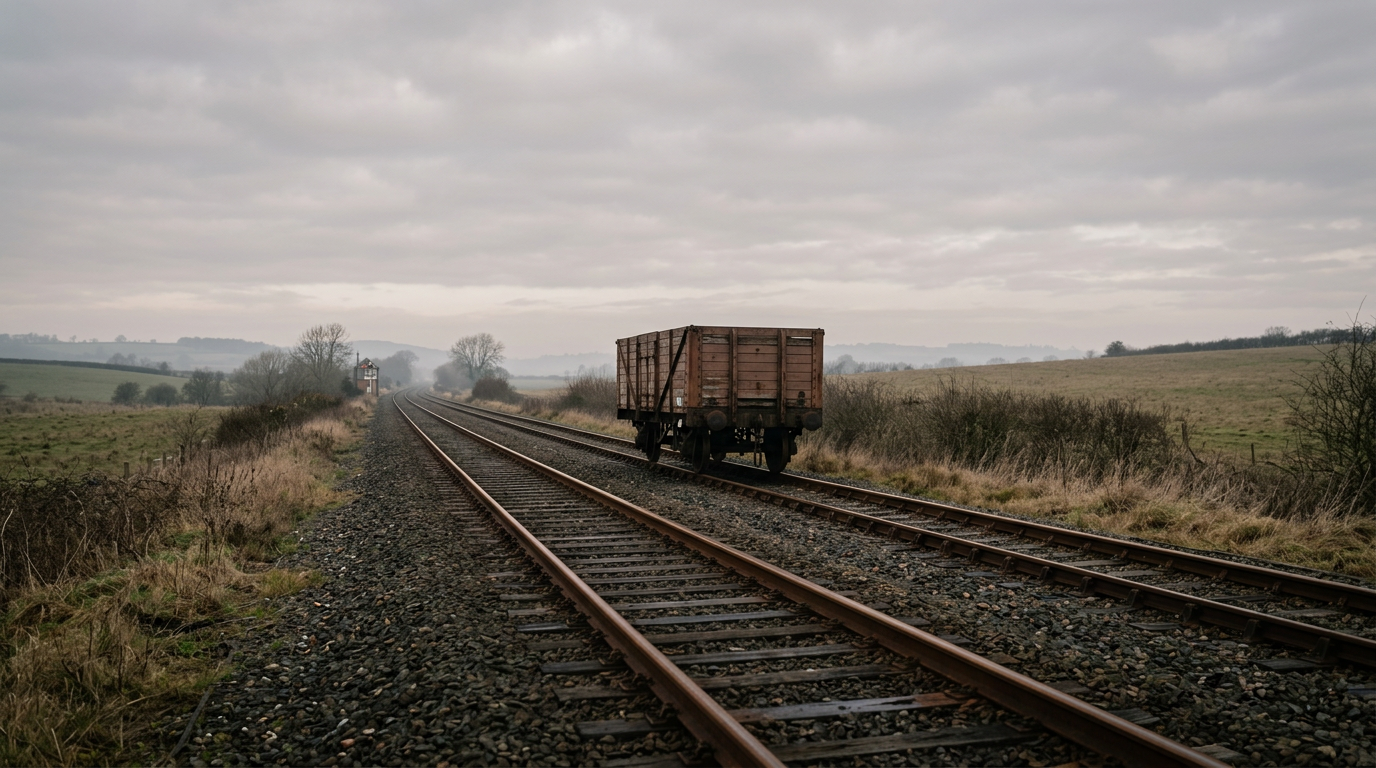
Will Rogers, the Cherokee-American cowboy philosopher, delivered this line during the early 20th century, a time when the American landscape was being physically and economically reshaped by the literal tracks of the railroad and the rise of the automobile. The metaphor is industrial and unforgiving.
Unlike other motivational tropes that focus on finding the path, Rogers assumes you have already found it. The tension lies in the fact that the right track is often the most crowded and dangerous place to linger.
According to researchers at the University of Pennsylvania, the psychological phenomenon of the arrival fallacy suggests that reaching a goal rarely provides the lasting satisfaction we expect. Rogers understood this intuitively. In his view, the track is not a destination but a conduit. If you treat a thoroughfare like a lounge, the inevitable result is a collision.
The Context of the Cowboy Philosopher
Rogers was the highest-paid Hollywood star of his era, but he maintained a reputation for plain-spoken grit. He lived through the transition from horse-and-buggy to the jet age, witnessing firsthand how quickly yesterday’s innovations became today’s wreckage.
Practical Applications
- Business: A market-leading product requires constant iteration; resting on a patent is a recipe for obsolescence.
- Career: Skills have a half-life. Being qualified for your job today does not guarantee you will be qualified for it in three years.
- Personal Growth: Habits are not static achievements but daily maintenance.
Similar Perspectives
- Contrasting View: The Slow Movement suggests that constant speed leads to burnout and that sitting still is necessary for reflection.
- Parallel Thought: Satchel Paige famously said, Don’t look back. Something might be gaining on you.
- Cultural Reference: The Red Queen’s Race in Lewis Carroll’s Through the Looking-Glass, where one must run just to stay in the same place.
Does this quote mean we should never rest?
No. It suggests that rest should not be mistaken for a permanent state of arrival. Tactical recovery is part of the movement; complacency is the danger.
What is the origin of the railroad metaphor?
In the 1920s, the railway was the primary symbol of progress. Rogers used the image of the track because it represented a clear, proven route that was nonetheless lethal to the stationary.
How does this apply to modern technology?
It mirrors the concept of technical debt. If a company stops updating its infrastructure while on the right track, the sheer volume of new data and users will eventually crash the system.
Key Takeaways
- Rightness: Being correct is not a shield against being overtaken.
- Inertia: Stagnation is a choice that carries a high price tag.
- Movement: Continuous improvement is the only way to stay on the track you worked hard to find.
Related Reading:
- The psychology of momentum and why it matters
- How to avoid the trap of the arrival fallacy
- Why the most successful people are never satisfied
Historical Context
Will Rogers, the renowned Cherokee-American cowboy philosopher, uttered this insightful remark during the early 20th century. This period in America was characterised by significant industrialisation and rapid change, with the landscape being dramatically reshaped by the expansion of railroads and the burgeoning automobile industry. Rogers' metaphor, therefore, draws directly from the tangible and often unforgiving reality of train tracks and the dangers of standing still on them. It speaks to an era where progress was visibly linked to momentum and continuous movement.
Meaning & Interpretation
This quote serves as a powerful warning against complacency, even when one has achieved a degree of success or is heading in the correct direction. It means that simply having the right strategy, idea, or being on the 'right path' is insufficient if you fail to act, adapt, or maintain momentum. The 'track' represents progress or a chosen course, while being 'run over' signifies being overtaken, made irrelevant, or suffering negative consequences due to stagnation. It underscores that the world is dynamic, and standing still, even in a good position, makes one vulnerable.
When to Use This Quote
This quote is highly relevant in situations demanding continuous innovation and adaptation. It's perfect for motivating teams in fast-paced industries like technology, encouraging start-ups to keep iterating, or for business leaders highlighting the perils of market stagnation. It can also be used in personal development contexts to stress the importance of ongoing learning and effort, even after achieving a goal. Essentially, it applies whenever there's a risk of complacency despite initial success or a correct strategy, urging proactive engagement rather than passive observation.
Frequently Asked Questions
Sources & References
 Encyclopaedia BritannicaThis source confirms biographical details about Will Rogers, describing him as a cowboy, humorist, and entertainer who became the highest-paid Hollywood star.britannica.com
- 2Albert Einstein — WikiquoteThis source provides a collection of documented quotations attributed to Will Rogers, a key figure in the article.en.wikiquote.org
 WikipediaThis source offers detailed biographical information about Will Rogers, including his career as a performer, actor, and social critic, and his death in a plane crash.en.wikipedia.org