
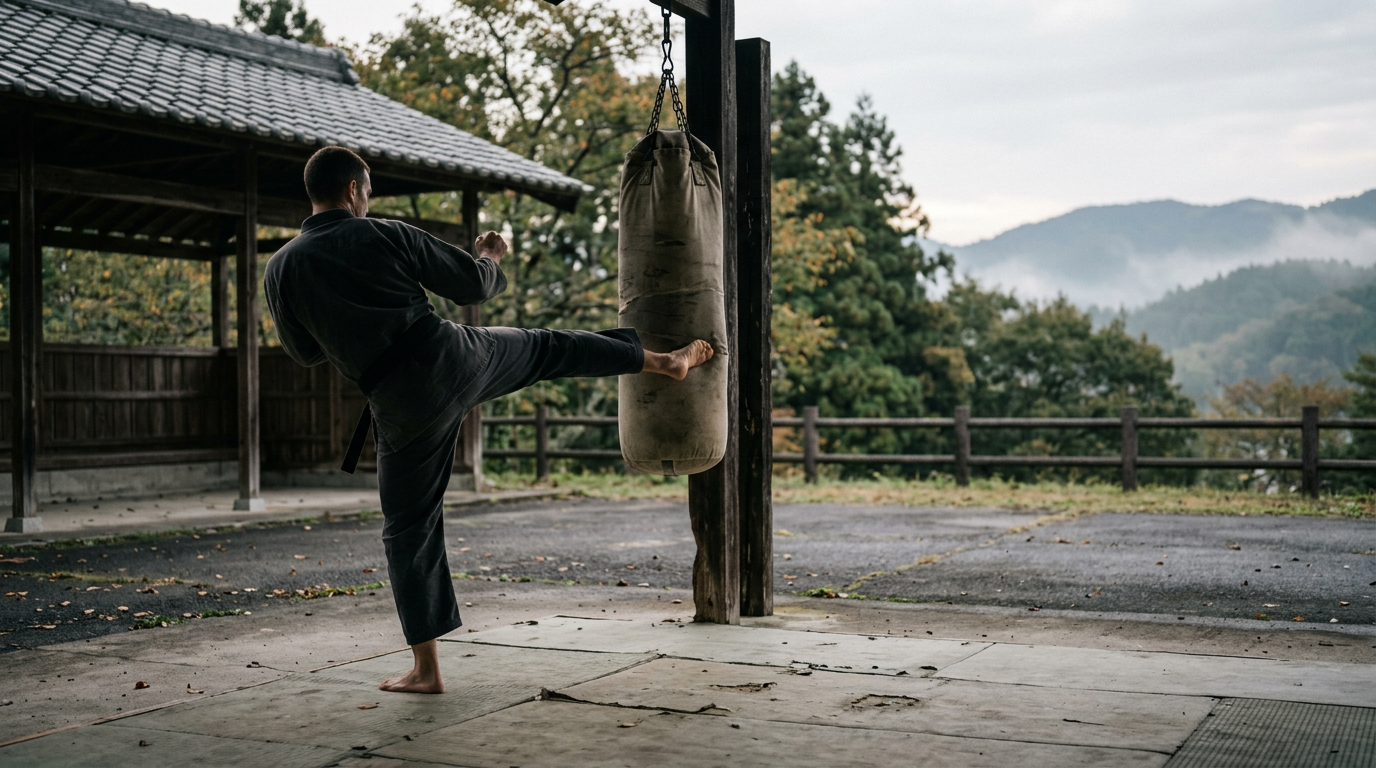
In a hurry? TL;DR
- 1Prioritize deep mastery of one core skill over dabbling in many to achieve true expertise.
- 2Relentless repetition and focus are key to developing subconscious execution and peak performance.
- 3Avoid the trap of 'variety,' which can mask a lack of discipline and decisiveness.
- 4True mastery is achieved through refining a single action to perfection, not adding more skills.
- 5Invest significant time and deliberate practice in one area to become a formidable force.
- 6Apply the '10,000 kicks' principle to your career, communication, and creative pursuits for greater impact.
Why It Matters
This quote is interesting because it teaches us that true expertise comes from deeply mastering one thing, not from knowing a little about many.
Bruce Lee’s most famous maxim suggests that true power is found in depth rather than breadth. It is an argument for mastery through repetition, asserting that a single, perfected skill is more dangerous than a thousand mediocre ones.
- Depth over width: Excellence requires narrow, relentless focus.
- The danger of distraction: Knowing a little about everything creates a false sense of security.
- The power of muscle memory: Mastery allows for reaction without conscious thought.
- Skill as a weapon: A simple tool, wielded perfectly, becomes unstoppable.
Understanding this quote helps separate the hobbyist from the professional, reminding us that competence is a function of time and repetition.
The Lethal Edge of Narrow Focus
Bruce Lee was not merely talking about martial arts; he was describing the psychology of performance. The quote highlights a fundamental truth about human capability: variety is often a mask for lack of discipline. In a fight, the person who has dabbled in ten thousand techniques will hesitate, cycling through options while their opponent acts on instinct.
Unlike the Victorian ideal of the polymath, Lee championed the specialist. He believed that by stripping away the unnecessary, one could reach a state of subconscious execution. This mirrors the concept of Deep Work popularized by modern productivity experts, where cognitive resources are poured into a single, high-value task to achieve elite results.
Lee’s philosophy was heavily influenced by his development of Jeet Kune Do, which he called the style of no style. He observed that traditional martial arts were often cluttered with ornamental movements that served no practical purpose. By contrast, his focused approach was designed for maximum efficiency.
A 2007 study published in the journal Nature suggested that it takes roughly ten years of intense practice to achieve world-class expertise in any field. Lee’s 10,000 kicks serves as a poetic precursor to this ten-thousand-hour rule, emphasizing that there are no shortcuts to becoming a formidable force.
Practical Applications
Mastery in the workplace: Instead of trying to learn every new software tool, become the undisputed expert in the one that drives the most value for your career.
Communication: Focus on mastering the art of the clear, concise email rather than attempting to adopt every new social media trend or networking gimmick.
Creative output: A writer who masters the structure of a short story will often produce more impactful work than one who starts ten different novels but finishes none.
Historical Context
Lee shared these thoughts during a period when martial arts were often shrouded in mysticism and rigid tradition. By focusing on the singular kick, he was rebelling against the overly complex forms (kata) of traditional karate and kung fu. He wanted to bring combat back to its most visceral, effective roots.
Related Concepts
- The 10,000 Hour Rule: The theory that elite expertise requires a specific threshold of practice.
- The Pareto Principle: The idea that 80 percent of results come from 20 percent of efforts.
- Occam’s Razor: The philosophical preference for simplicity over complexity.
Does this mean I shouldn't learn new things?
No. It means you should not confuse exposure with expertise. Broad knowledge is useful for perspective, but success usually requires a primary, highly-refined skill.
How do I choose my one kick?
Identify the task or skill that has the highest impact on your goals and requires the most technical precision to execute under pressure.
Is repetition enough for mastery?
Repetition alone is not enough; it must be deliberate practice. You must actively look for and correct flaws during every one of those 10,000 repetitions.
Key Takeaways
- Consistency beats intensity: Small, daily refinements lead to massive long-term advantages.
- Eliminate the noise: Identify the techniques or habits that don't contribute to your core goal and discard them.
- Trust the process: Mastery is often boring, involving the endless repetition of the basics.
- Be the specialist: In a world of generalists, the person with one perfected skill is the one people fear.
Historical Context
This renowned maxim is attributed to Bruce Lee, the legendary martial artist, philosopher, and film star of the 20th century. While the exact date and setting of its utterance aren't universally documented, it encapsulates his core philosophy on martial arts training and life mastery, developed during his intense dedication to Jeet Kune Do. He was a vocal proponent of efficiency and practical application, challenging traditional, often rigid, martial arts styles of his era. This quote became a cornerstone of his teachings, reflecting his emphasis on functional skill development over superficial knowledge, influencing not just martial artists but also wider audiences seeking self-improvement.
Meaning & Interpretation
In plain terms, this quote means that deep, repetitive practice of a single skill is far more effective and potent than a superficial understanding of many different skills. Lee argues that true expertise and formidable ability stem from perfecting one core competence through countless repetitions, leading to an almost automatic, instinctual execution. Someone who has practiced a single 'kick' ten thousand times will possess unparalleled precision, power, and speed with that move, making them far more dangerous and effective than someone who has merely dabbled in ten thousand different kicks without mastering any.
When to Use This Quote
This quote is highly relevant in situations demanding mastery and efficiency, particularly in competitive or high-stakes environments. It's useful when discussing the importance of specialisation over generalism in professional development, advocating for deep work and focused practice in any skill acquisition. You could employ it when motivating individuals or teams to concentrate efforts on core competencies rather than getting distracted by numerous, less critical tasks. It's also apt when explaining why relentless iteration and refinement of a single product or service can lead to market dominance, or when cautioning against spreading resources too thinly.
Frequently Asked Questions
Sources & References
- 1Albert Einstein — WikiquoteThis page documents various quotations attributed to Bruce Lee, including the one about practicing one kick 10,000 times.en.wikiquote.org
 WikipediaThis Wikipedia page provides extensive biographical information about Bruce Lee, covering his life, career, and philosophy.en.wikipedia.org
- WikipediaThis page describes Jeet Kune Do, the martial art philosophy developed by Bruce Lee, which is central to his 'style of no style' approach mentioned in the article.en.wikipedia.org