
In a hurry? TL;DR
- 1Embrace suffering as a necessary mechanism for growth rather than a sign of failure, recognizing it as the sensation of progress reshaping your former self.
- 2View self-improvement as an act of deliberate subtraction, focusing on cutting away flaws and old habits rather than simply adding new, superficial features to your personality.
- 3Accept full personal agency by acknowledging that you are the sole sculptor of your character, responsible for the painful but essential decisions that drive your transformation.
- 4Actively combat complacency by choosing to challenge your current limitations, understanding that true evolution often requires a period of personal demolition before building something new.
- 5Shift your perspective on struggle to realize that changing deep-seated habits is inherently destructive to your current identity, and this friction is where true excellence is forged.
Why It Matters
This perspective is useful because it reframes personal struggle as the essential mechanism of growth rather than a sign that something has gone wrong.
Alexis Carrel’s observation captures the violent necessity of self-improvement: you are simultaneously the artist and the raw material, meaning every blow of the chisel is felt as a wound. It suggests that personal evolution is not a passive unfolding but a deliberate, often painful process of subtraction.
The Core Concept
- Resistance: Personal growth requires overcoming the natural inertia of your current self.
- Subtraction: Improvement is often about removing flaws rather than adding new features.
- Agency: You are the only person capable of performing the necessary, painful cuts.
- Transformation: Suffering is not a side effect of change; it is the mechanism of change.
Why It Matters
This quote reframes struggle not as a sign of failure, but as the literal sensation of progress occurring at the expense of your former limitations.
The Agony of the Chisel
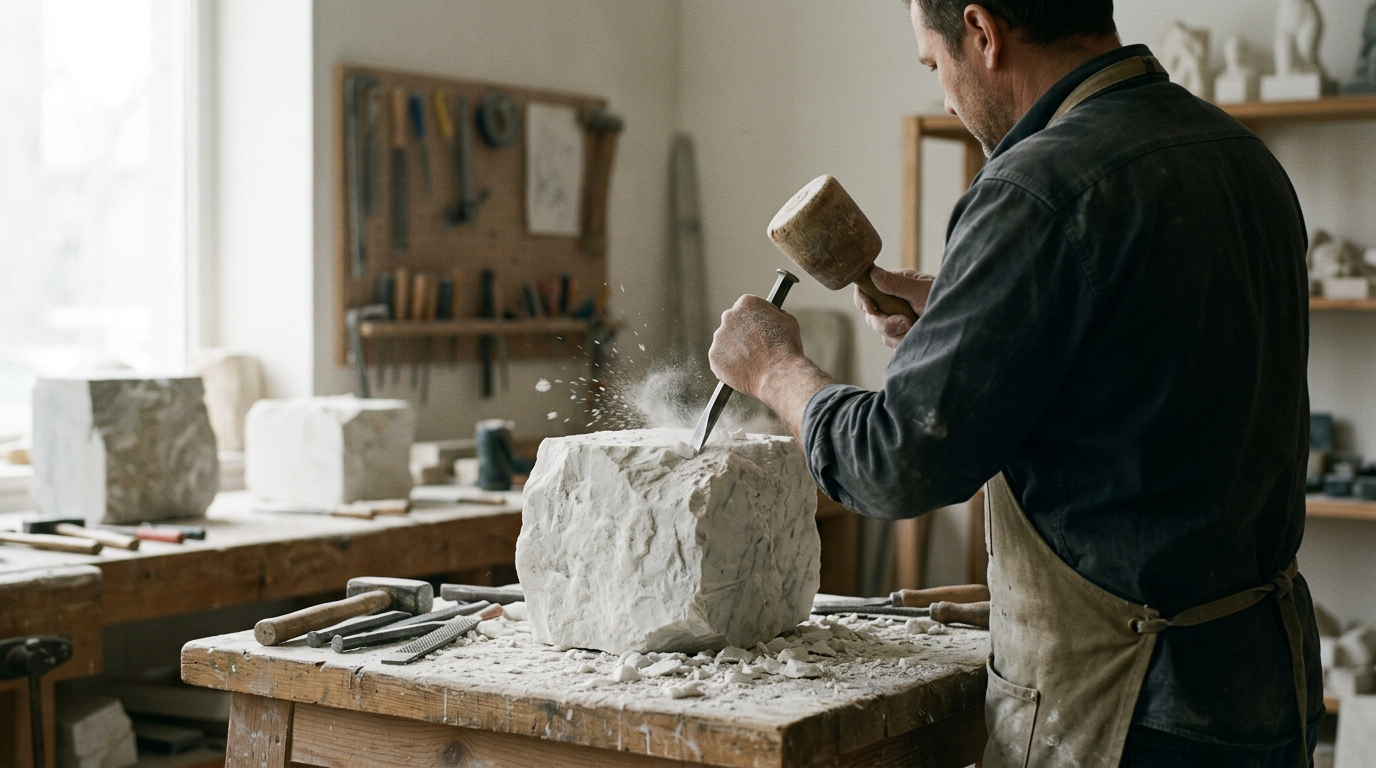
Carrel’s metaphor strips away the romanticism of self-help. Unlike a block of Carrara marble, which is indifferent to the sculptor’s hammer, the human subject feels every chip. To change a habit, a belief, or a lifestyle, you must effectively kill a part of your existing identity.
The power of this imagery lies in the duality of the self. While most philosophies treat the mind and body as separate entities, Carrel, a Nobel Prize-winning surgeon, viewed the human being as a physiological whole. In his 1935 work, Man, The Unknown, he argued that modern comforts had softened humanity, leading to a decline in the grit required for true excellence.
Unlike the stoic notion that we should merely endure pain, Carrel suggests we must actively inflict it upon our own complacency. The sculptor does not gently persuade the stone into a shape; they strike it. This perspective provides a necessary counter-narrative to the modern idea that growth should be a seamless, painless journey of discovery.
Context and Controversy
Carrel’s views were deeply shaped by his medical background. He understood that healing often requires an initial trauma, such as a surgical incision. However, his work is also shadowed by his advocacy for eugenics, a reminder that the desire to remake humanity can take dark, authoritarian turns when applied to society rather than the individual.
Practical Applications
- Habit Breaking: View the discomfort of quitting a vice as the physical sensation of the sculptor removing excess stone.
- Skill Acquisition: Accept that the frustration of being a novice is the necessary friction of shaping new neural pathways.
- Resilience: When facing hardship, ask which part of your character is currently being refined or removed.
Interesting Connections
- Michelangelo’s Prisoners: The famous sculptor believed the statue was already inside the stone, and his job was merely to set it free.
- Nietzschean Overman: Friedrich Nietzsche similarly argued that one must be willing to burn in their own flame to become new.
- Kintsugi: The Japanese art of repairing broken pottery with gold, suggesting that the marks of suffering can become the most beautiful part of the work.
Why is suffering necessary for change?
According to Carrel, the current version of yourself is held together by biological and psychological inertia. Breaking that inertia requires energy and friction, which the human brain perceives as discomfort or pain.
Does this mean all suffering is productive?
No. Carrel distinguishes between the purposeless suffering of decay and the purposeful suffering of the sculptor. One destroys the marble; the other shapes it.
How does this compare to modern psychology?
Modern concepts like post-traumatic growth and cognitive dissonance echo Carrel’s sentiment, suggesting that psychological tension is often the precursor to significant breakthroughs in perspective.
Key Takeaways
- Self-mastery: You are both the subject and the object of your own discipline.
- Resistance as Guide: The areas where you feel the most resistance are often where the most significant carving needs to happen.
- Active Participation: You cannot wait for time to change you; you must pick up the tools and do the work yourself.
Related Reading
Historical Context
This aphorism originates from the 1935 best-selling work 'Man, The Unknown' ('L'Homme, cet inconnu') by French surgeon, biologist, and Nobel laureate Alexis Carrel. Writing during the interwar period, Carrel observed the rapid rise of industrialisation and modern comforts with profound scepticism. He contended that contemporary society had softened humanity, encouraging intellectual and physical lethargy. As an experienced vascular surgeon, Carrel understood regeneration through a clinical lens, viewing pain not as an evil to be avoided at all costs, but as an indispensable biological and spiritual catalyst required to arrest civilisational decline and forge resilient individuals.
Meaning & Interpretation
True personal transformation demands anguish because one must consciously dismantle parts of one's existing identity to build something better. In conventional art, a block of stone feels nothing as it is shaped by an external creator; in human development, the subject must wield the chisel against their own substance. Improving oneself is therefore fundamentally subtractive, requiring the painful elimination of bad habits, comforting illusions, and entrenched weaknesses. Suffering is not a cruel side effect or an indicator of failure, but the precise mechanism through which deliberate evolution and self-mastery occur.
When to Use This Quote
This sentiment is ideal when encouraging someone undergoing an arduous period of self-discipline, such as rehabilitation, rigorous athletic training, or a difficult career pivot. It serves as a potent reminder during moments of doubt that psychological or physical discomfort is a natural consequence of growth. It is particularly effective in mentoring and coaching contexts to reframe struggle as proof of constructive progress rather than defeat.
Frequently Asked Questions
Sources & References
- 1Albert Einstein — WikiquoteDocuments Alexis Carrel's quotation regarding man remaking himself through suffering as both the marble and the sculptor from his 1935 work, Man, The Unknown.en.wikiquote.org
 Encyclopaedia BritannicaProvides biographical information on French surgeon Alexis Carrel, his 1912 Nobel Prize, and his publication of Man, The Unknown.britannica.com
- 3Albert Einstein - BiographicalDetails Alexis Carrel's Nobel Prize in Physiology or Medicine in 1912 for his pioneering work on vascular suturing and organ transplantation.nobelprize.org