
About Mikhail Lermontov
In a hurry? TL;DR
- 1Embrace early career turbulence as necessary momentum; understand that intense, chaotic phases are natural prerequisites for long-term stability and are not meant to last indefinitely.
- 2Refine your raw, youthful energy into focused direction, shifting from ego-driven volatility toward the steady, purposeful current required to reach your ultimate professional or personal destination.
- 3Recognize that high-stress, high-energy periods are temporary transitions; use this perspective to manage burnout by acknowledging that your current friction is part of a larger, evolving journey.
- 4Prioritize sustainable progress over constant intensity, understanding that a river that foams destructively all the way to the sea is less effective than a calm, channeled stream.
- 5View personal growth as a biological evolution; just as physics dissipates waterfall energy, trust that time and experience will naturally refine your passion into a steady, influential force.
- 6Avoid the trap of romanticizing perpetual chaos, realizing that the ultimate goal of your efforts is to achieve the depth and reliability of a calm, purposeful river.
Why It Matters
This perspective is useful because it reframes the overwhelming chaos of new beginnings as the essential momentum required to forge a stable and purposeful life.
Mikhail Lermontov’s metaphor suggests that intense, chaotic beginnings are a natural prerequisite for eventual stability. It argues that youthful turbulence is not a permanent state, but a necessary phase of momentum that eventually settles into a purposeful flow.
- Intensity is temporary: High-energy chaos cannot be sustained indefinitely.
- Maturity as a river: The transition from waterfall to river represents the shift from raw ego to focused direction.
- Inevitable cooling: Just as physics demands a waterfall dissipate its energy, time demands that human passion finds a channel.
- The destination matters: The foam is spectacular, but the calm river is what actually reaches the ocean.
This quote serves as a biological and psychological reality check for anyone overwhelmed by the friction of a new venture or the volatility of youth.
What the quote means
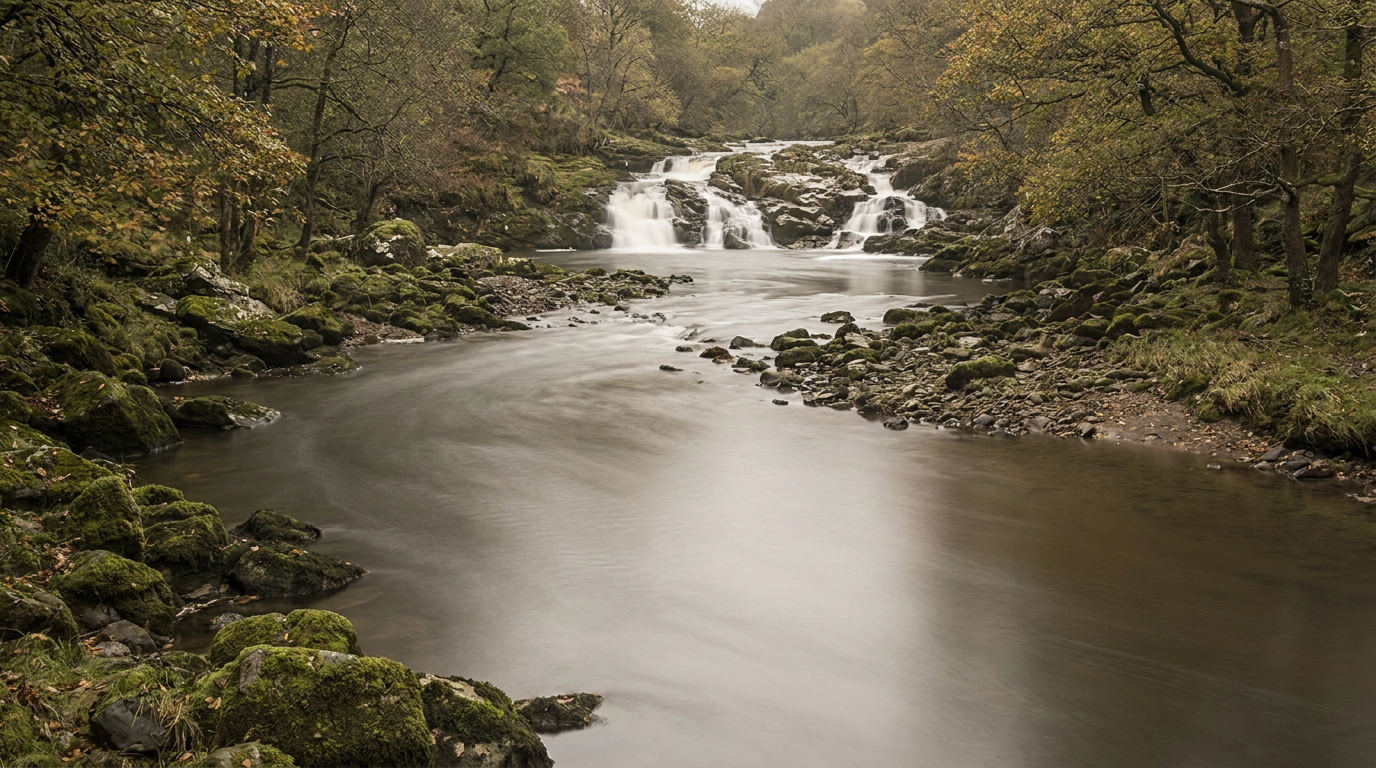
Lermontov captures the physics of personal growth. We often mistake the noise and spray of a waterfall for its total identity, but the waterfall is merely the river’s most violent transition. The energy that feels like it might tear us apart in our twenties or at the start of a career is the exact same energy that later provides the depth and steady current of a seasoned life.
The insight here is about the exhaustion of ego. A waterfall hurtles because it has no choice; gravity and terrain dictate its path. As the terrain levels out, the water finds its banks. This is not a loss of power, but a refinement of it. A river that foams all the way to the sea is a flood, and a flood leaves nothing behind but destruction.
About the author
Mikhail Lermontov was the quintessential Romantic rebel of 19th-century Russia, often called the Poet of the Caucasus. He lived a life that mirrored his own metaphor, defined by exile, duels, and restless energy.
The Romantic context
Lermontov wrote during the peak of European Romanticism, a movement obsessed with the sublime power of nature. While his peers often glorified the storm for its own sake, Lermontov’s observation in A Hero of Our Time is more cynical and grounded. He understood that the high-pitched intensity of the Byronic hero was a phase, not a lifestyle. In contrast to the wilder poetry of the era, this quote acknowledges that the end goal of all that turbulence is, ironically, the silence of the sea.
Practical applications
- Manage your burnout: Recognise that your current high-stress phase is a waterfall; it is mechanically impossible for it to stay this loud forever.
- Evaluate your progress: If you are still foaming years into a project, you haven't found your banks yet—look for ways to channel that energy into a steady current.
- Forgive your past: Stop cringing at your youthful turbulence; it was the gravity required to get you moving.
Similar perspectives
- The Tao Te Ching: Lao Tzu often noted that the stiff and unbending is the disciple of death, while the fluid and soft is the disciple of life.
- Aristotle’s Golden Mean: The idea that virtue is the stable middle ground between two volatile extremes.
- Heraclitus: Famous for the idea that no man ever steps in the same river twice, emphasising that change is the only constant.
What book is this quote from?
It appears in Lermontov's 1840 novel, A Hero of Our Time, specifically within the journal of the protagonist, Pechorin.
Is the quote about aging?
While it applies to aging, it is more accurately about the lifecycle of passion and ambition in any context, from relationships to revolutions.
What does the sea represent?
In literature, the sea often represents death, the collective unconscious, or the final achievement of a goal where the individual self dissolves into something larger.
Key Takeaways
- Turbulence is a starting point, not a permanent character trait.
- Sustained success requires the transition from noise to depth.
- Do not fear the loss of your initial fire; it is simply becoming a more efficient heat source.
- Peace is the natural conclusion of a life well-driven.
Learn more about the Philosophy of Stoicism, read our breakdown of The Byronic Hero, or explore The Physics of Flow.
Historical Context
Mikhail Lermontov, one of Russian literature’s most prominent Romantic figures, wrote during a period of deep political disenchantment and personal unrest in nineteenth-century Tsarist Russia. Renowned for his brooding cynicism, fiery temperament, and untimely death in an 1841 duel, Lermontov frequently employed dramatic natural metaphors to explore human psychology. This reflection speaks directly to the journey from youthful angst to philosophical maturity, mirroring the Romantic fascination with nature's sublime power alongside the inevitable temperance of rebellious passion as one navigates the broader currents of existence.
Meaning & Interpretation
The quote observes that volatility and chaos are natural early phases of development rather than permanent states of being. Lermontov uses the physical progression of water to illustrate that raw energy cannot sustain its highest intensity indefinitely without self-destruction. Just as a violent cataract inevitably broadens into a steady, deep river to complete its journey to the ocean, human beings must transition from chaotic, reactive ambition into focused, quiet momentum. Maturation does not signify a loss of power; rather, it represents the refinement of initial friction into disciplined, enduring strength.
When to Use This Quote
This quotation is particularly fitting when reassuring someone overwhelmed by the chaos of a new enterprise, a career transition, or early adulthood. It offers comfort during periods of intense personal friction or creative turbulence, providing a reminder that instability is simply an early developmental stage. It works well in mentorship settings, graduation addresses, or supportive correspondence to encourage patience, resilience, and perspective.
Frequently Asked Questions
Sources & References
- 1Albert Einstein — WikiquotePresents documented quotations and literary excerpts by Russian Romantic writer Mikhail Lermontov.en.wikiquote.org
 Encyclopaedia BritannicaDetails the life, literary career, and fatal duel of Russian poet and novelist Mikhail Lermontov.britannica.com
 WikipediaProvides background and literary analysis of Mikhail Lermontov's celebrated 1840 novel, A Hero of Our Time.en.wikipedia.org