
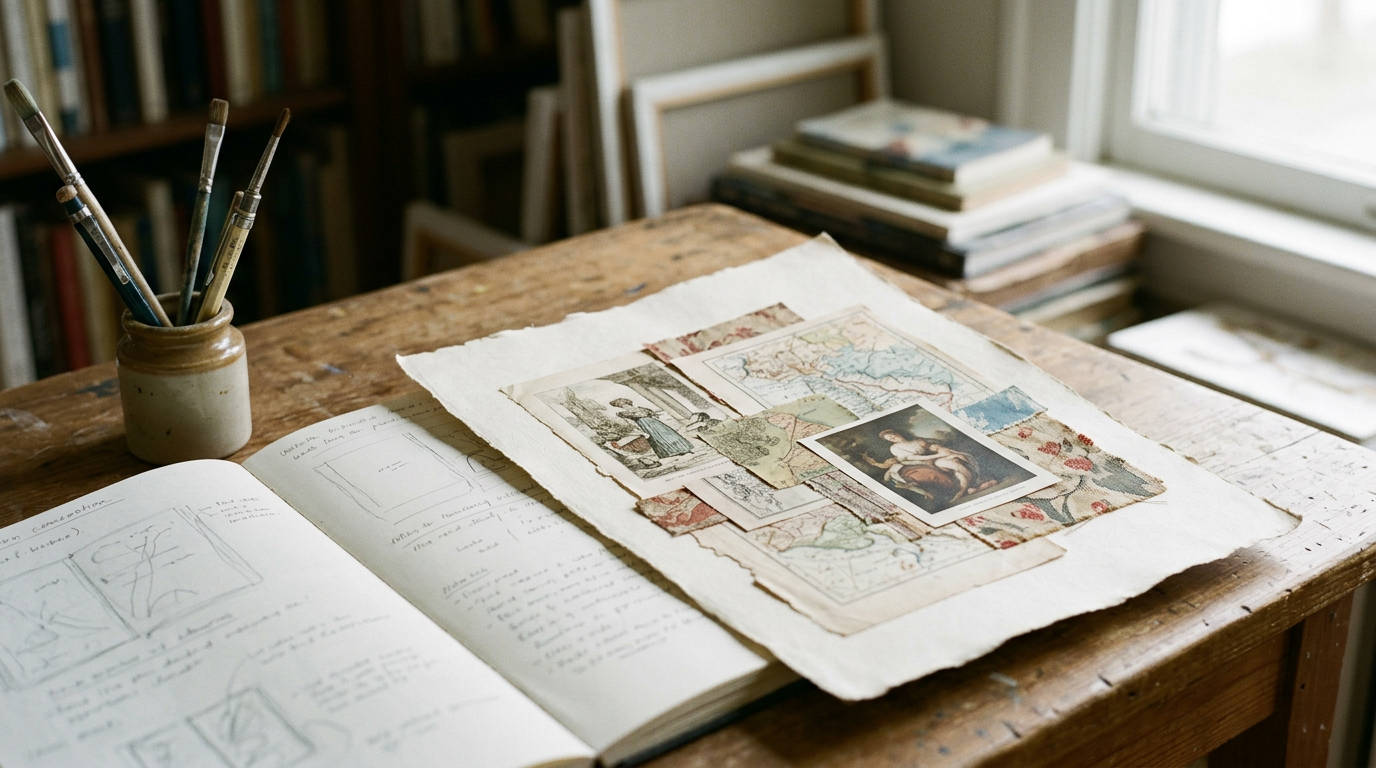
Quick Answer
Pastiche is art made by copying the style of others or by mixing different elements together. It's fascinating because it’s often a way for artists to pay homage to their influences, showing a playful yet respectful connection to what has come before. It’s like a creative nod to the past.
In a hurry? TL;DR
- 1Pastiche is a creative work deliberately imitating or blending styles from past artists, periods, or genres.
- 2Unlike parody, pastiche is a sincere tribute, celebrating its influences rather than mocking them.
- 3Successful pastiche requires a deep understanding of the original style's techniques and materials.
- 4Architects and authors use pastiche to create harmony with historical surroundings or literary canons.
- 5The intent behind pastiche is key, relying on the audience recognizing the homage to source material.
- 6Pastiche can be found in film, literature, architecture, and various other creative fields as a form of respectful borrowing.
Why It Matters
Pastiche is interesting because it reveals how artists thoughtfully borrow from the past as a form of tribute, rather than simply copying or mocking it.
Pastiche is an artistic work that imitates the style of a previous artist, period, or genre, or a composition made up of selections from various sources. It is distinct from parody because it celebrates its influences rather than mocking them.
The Quick Reference
Part of Speech: Noun / Verb Pronunciation: pas-TEESH (/pæsˈtiːʃ/) Core Meaning: A creative work that mimics or blends different styles or sources.
Why It Matters
Understanding pastiche allows you to distinguish between lazy copying and deliberate, respectful homage in everything from Tarantino films to interior design.
The Art of the Borrowed Style
Pastiche exists because no creator works in a vacuum. While a parody borrows a style to ridicule it, a pastiche borrows a style as a tribute. It is the sincerity that defines the word. If you watch a modern film that looks and feels exactly like a 1970s techno-thriller, you are witnessing a pastiche.
Architects often use this approach when designing new buildings in historic districts. Rather than clashing with the surroundings, they create a pastiche of the local Victorian or Georgian style to maintain aesthetic harmony. According to critics at the Royal Institute of British Architects, successful pastiche requires a deep technical understanding of the original era’s proportions and materials.
In literature, the Sherlock Holmes series has spawned countless pastiches. Authors like Anthony Horowitz have written new mysteries that replicate Arthur Conan Doyle’s specific Victorian syntax and Watson’s narrative voice. Unlike a satirical take on the detective, these works aim to be indistinguishable from the original canon.
Examples in Context
- The film was a loving pastiche of 1950s sci-fi, complete with grainy film stock and practical effects.
- Critics dismissed the gallery show as a derivative pastiche of Warhol, lacking any original spark.
- Her debut novel is a clever pastiche of Gothic horror tropes and modern digital slang.
- The architect was praised for his pastiche of the neighbouring cathedral’s stonework.
Related Concepts
- Parody: An imitation designed for comedic effect or social commentary.
- Homage: An explicit acknowledgement or tribute to an influence.
- Bricolage: Construction or creation from a diverse range of available things.
- Collage: An artistic composition of materials and objects pasted over a surface.
Usage Tips
Use pastiche when you want to describe something that feels like a patchwork or a stylistic mimicry. Use it as a noun to describe the object itself, or as a verb when describing the act of imitating. Avoid using it as a synonym for forgery; a pastiche is meant to be recognised as an imitation, whereas a forgery is meant to deceive.
Is pastiche an insult?
Not necessarily. While some critics use it to describe work they find unoriginal, it is more often used as a neutral technical term for stylistic imitation or a positive term for a skilled tribute.
How is it different from an homage?
An homage is a specific nod or reference within a larger work. A pastiche is a work that is built entirely in the style of its influence.
Can music be a pastiche?
Yes. Many modern pop songs are pastiches of 80s synth-wave or 70s disco, using the specific instruments and production techniques of those decades to evoke a certain mood.
Key Takeaways
- Pastiche is a respectful imitation or a medley of different styles.
- It differs from parody because it lacks the intent to mock or satirise.
- The word's roots lie in the Italian word for a mixed-ingredient pie.
- It is a vital tool for creators who want to evoke nostalgia or honour their predecessors.
Example Sentences
"The new television series was a brilliant pastiche of 1980s detective dramas, complete with cheesy synth music and exaggerated fashion."
"Her latest novel is a pastiche of several classic gothic tales, blending their atmospheric elements into a modern narrative."
"The architect designed a subtle pastiche of Georgian elements to ensure the new extension harmonised with the existing historic building."
"Critics praised the film for its clever pastiche, acknowledging its respectful homage to classic Hollywood musicals."
"His artistic style is a pastiche of impressionist brushstrokes and cubist fragmentation, creating a unique visual language."
Frequently Asked Questions
Sources & References
 Merriam-WebsterPastiche is defined as a literary, artistic, musical, or architectural work that imitates the style of previous work, or a hodgepodge of motifs or subjects borrowed from different sources.merriam-webster.com
- 2Online Etymology DictionaryThe word 'pastiche' entered English in 1878, derived from the French 'pastiche,' which came from the Italian 'pasticcio,' meaning a pie or medley, originally referring to a mix of pasta or a literary/musical medley.etymonline.com