
Quick Answer
Compaction is the process of squeezing particles together to remove empty space, creating a denser and more stable material. It is a fundamental physical principle that shapes our world in remarkable ways. Without compaction, the ground would lack the structural integrity to support massive skyscrapers, and your body could not function. It is even responsible for packing two metres of complex DNA into every single one of your microscopic cells. This simple act of pressing things together is the
In a hurry? TL;DR
- 1Understand that compaction is the systematic process of increasing density and structural integrity by removing empty space between particles, rather than simply reducing overall volume.
- 2Apply compaction in engineering contexts to ensure materials like soil or gravel can support significant loads, preventing structural failures in infrastructure like roads and buildings.
- 3Utilize mechanical compaction in logistics and waste management to improve efficiency, such as using hydraulic presses to increase transport capacity by a factor of five.
- 4Recognize the role of natural compaction in geology, where persistent pressure over time transforms raw organic matter into stable, dense resources like coal.
- 5Optimize digital storage systems by using data compaction algorithms to rearrange fragmented blocks, thereby reclaiming unused space and improving server efficiency.
- 6Distinguish between compaction and compression; use compaction when emphasizing internal unity and stability, and compression when focusing on external pressure or size reduction.
Why It Matters
Compaction is a fascinating process because it reveals how packing matter tightly together creates the structural stability needed for everything from enduring motorways to housing our own DNA.
Compaction is the physical process of reducing the volume of a substance by pressing its particles closer together. It is the art of eliminating empty space to create density, stability, or efficiency.
- Word: Compaction
- Part of Speech: Noun
- Pronunciation: kuhm-PAK-shuhn (/kəmˈpækʃən/)
- Meaning: The act or process of firmly packing something together.
The Density of Utility
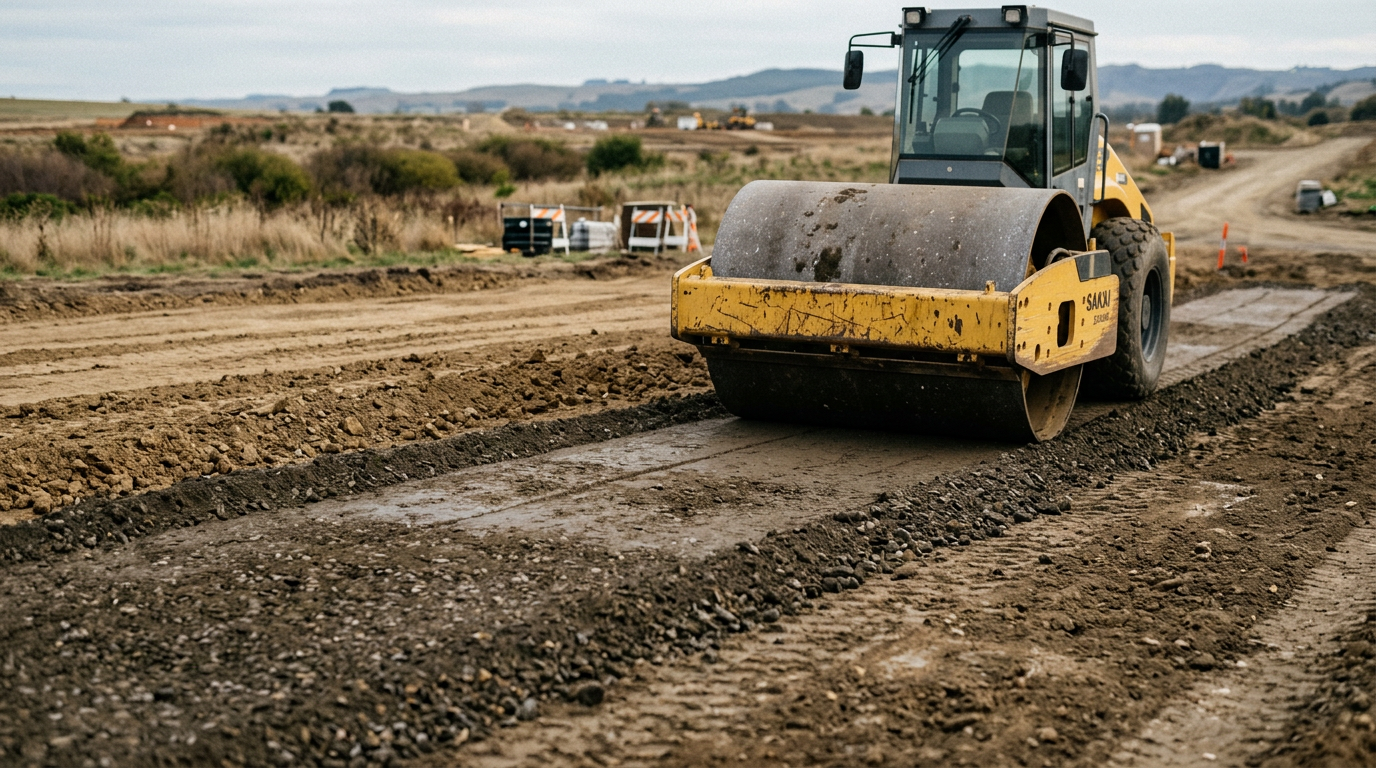
Compaction is not merely about making things smaller; it is about structural integrity. In civil engineering, it is the difference between a road that lasts decades and one that collapses under the first heavy rain. By removing air pockets from soil or gravel, engineers ensure the ground can support the weight of skyscrapers and bridges.
Unlike simple squashing, compaction often implies a systematic or natural mechanical force. In the world of waste management, it is a logistical necessity. Modern bin lorries use hydraulic press systems to achieve a compaction ratio of roughly 5:1, allowing a single vehicle to carry five times the loose rubbish it otherwise would.
The most impressive display of this word occurs in biology. Human DNA is roughly two metres long when stretched out, yet it must fit inside a cell nucleus only six micrometres wide. This is achieved through chromatin compaction, where threads of genetic code wrap tightly around proteins like thread on a spool.
Why It Matters
Understanding compaction helps you grasp how the physical world maintains its shape under pressure, from the skyscrapers above us to the genetic blueprints within us.
Examples in Context
- Natural Compaction: Over millions of years, the weight of overlying sediment caused the compaction of organic matter into coal.
- Data Management: Digital compaction algorithms allow servers to reclaim unused storage space by rearranging fragmented data blocks.
- Agriculture: Heavy machinery can cause soil compaction, which prevents oxygen and water from reaching the roots of crops.
- Physical Fitness: Some athletes focus on muscle compaction, aiming for dense, functional strength rather than purely aesthetic volume.
Related Concepts
- Synonyms: Compression, consolidation, densification, condensation.
- Antonyms: Rarefaction, expansion, dispersal, loosening.
Practical Usage Tips
Use compaction when referring to a process that increases density or stability. Use compression when the focus is primarily on the reduction of size or the application of external pressure. While often used interchangeably, compaction suggests a more permanent or structural change in the material involved.
Is compaction the same as compression?
While similar, compression is the act of pressing down, whereas compaction is the resulting state of increased density. In geology and engineering, compaction specifically refers to the displacement of air or water from between particles.
Why is soil compaction bad for gardens?
When soil becomes too dense, the pore spaces that hold air and water vanish. This prevents roots from expanding and stops beneficial organisms like earthworms from moving through the earth.
What is a compaction ratio?
This is a numerical expression of how much a material has been shrunk. A 4:1 ratio means the final material takes up only a quarter of its original volume.
Key Takeaways
- Core Function: Compaction eliminates voids to create a denser, more stable mass.
- Engineering Essential: It is the foundational process for building stable roads and foundations.
- Biological Marvel: It allows massive amounts of information to be stored in microscopic spaces.
- Variable Contexts: The term applies equally to heavy construction, digital data, and evolutionary biology.
Example Sentences
"Soil compaction caused by heavy farm machinery during wet weather can severely hinder root development and water drainage."
"Modern bin lorries use hydraulic mechanisms to achieve substantial waste compaction, reducing the frequency of trips to the tip."
"Before laying the tarmacadam for the new motorway, the roadbed underwent rigorous compaction to prevent structural subsidence."
"In molecular biology, the remarkable compaction of chromatin allows over two metres of human DNA to fit neatly inside a microscopic nucleus."
"Over millions of years, continuous geological compaction gradually transforms soft riverbed mud into dense sedimentary shale."
