Quick Summary
Boston merchant Frederic Tudor achieved what contemporaries called impossible by insulating frozen New England pond water with pine sawdust inside double-hulled sailing ships. Initially ridiculed and bankrupted twice, Tudor persevered by engineering insulated icehouses across the Caribbean and India, giving away free cold drinks to bartenders until patrons developed an appetite for chilled luxury. By treating ice as a manufactured commodity rather than perishable weather, he sparked an international commercial empire.
In a hurry? TL;DR
- 1Frederic Tudor began shipping pond ice from Massachusetts to Martinique in 1806.
- 2Early voyages failed financially because tropical ports lacked insulated storage facilities.
- 3Pine sawdust from Maine timber mills proved to be the decisive, low-cost insulator.
- 4Tudor manufactured consumer demand by offering free samples to barkeepers and doctors.
- 5Nathaniel Wyeth's horse-drawn ice cutter turned pond harvesting into an industrial process.
- 6By the 1840s, New England ice regularly crossed the equator to reach Havana, London, and Calcutta.
In February 1806, the brig Favourite sailed out of Boston Harbour laden with an eccentric cargo: 130 tonnes of solid ice cut by hand from a family estate in Saugus, Massachusetts. The ship was bound for the French Caribbean island of Martinique.
The local press was merciless. One Boston gazette noted dryly that the voyage was no ordinary venture, warning that the cargo would turn to bilge water long before crossing the Gulf Stream. When the ship arrived in the West Indies, residents were perplexed. Ice was something wealthy colonists read about in European memoirs, not an item expected to arrive sweating on a tropical quay.
Frederic Tudor lost nearly four thousand dollars on that maiden voyage. Most of the ice had survived the crossing, but because Martinique possessed no insulated storehouses, the cargo melted into the harbour mud before it could be sold. Tudor was ridiculed, sued, and repeatedly landed in debtor's prison. Yet over the subsequent three decades, he turned frozen pond water into one of New England's most lucrative exports, laying the logistical foundation for the modern cold chain.
The physics of sawdust
Tudor’s first technical dilemma was how to prevent the cargo from disappearing mid-Atlantic. Early experiments with straw, hay, and wool were disastrous. Straw trapped moisture, began to rot, and occasionally spontaneously combusted inside ship holds.
The answer lay in another regional waste product: pine sawdust from the timber mills of Maine. Packed tightly between double hulls and surrounding solid blocks of ice, dry sawdust acted as a remarkably effective thermal barrier. Because large blocks have a low surface-area-to-volume ratio, melting only affected the outer inches, while the core remained below freezing.
Tudor combined two valueless local materials—frozen lake water and scrap wood shavings—and transported them to markets where heat was relentless. It was an audacious exercise in pure arbitrage, deriving value not from manufacturing complexity, but from the geographic redistribution of temperature.
Inventing a taste for cold
Preserving the ice during the voyage solved only half the equation. Tudor still faced a cultural obstacle: nobody in the tropics believed they needed ice.
To build a market, Tudor adopted aggressive promotional tactics. Arriving in Havana, Kingston, and later New Orleans, he built bespoke above-ground icehouses with double walls packed with peat and wood shavings. He then offered barkeepers free ice for a year, teaching them to mix chilled cocktails, juleps, and punches. He gave free samples to physicians, arguing that cold water reduced tropical fevers.
Once customers tasted a cold drink in midsummer humidity, they refused to return to tepid rum. Ice shifted rapidly from an oddity into a mandatory comfort, transforming within a few seasons into an essential social signifier among colonial administrators, merchant elites, and high-end taverns. Tudor understood product adoption long before modern marketing codifiers existed: make the initial luxury accessible until habit renders it indispensable.
Industrialising the winter harvest
By the late 1820s, demand outstripped the physical limits of Tudor's manual harvesting methods. Men with axes and iron saws were too slow, and irregularly shaped chunks melted far quicker than uniform blocks.
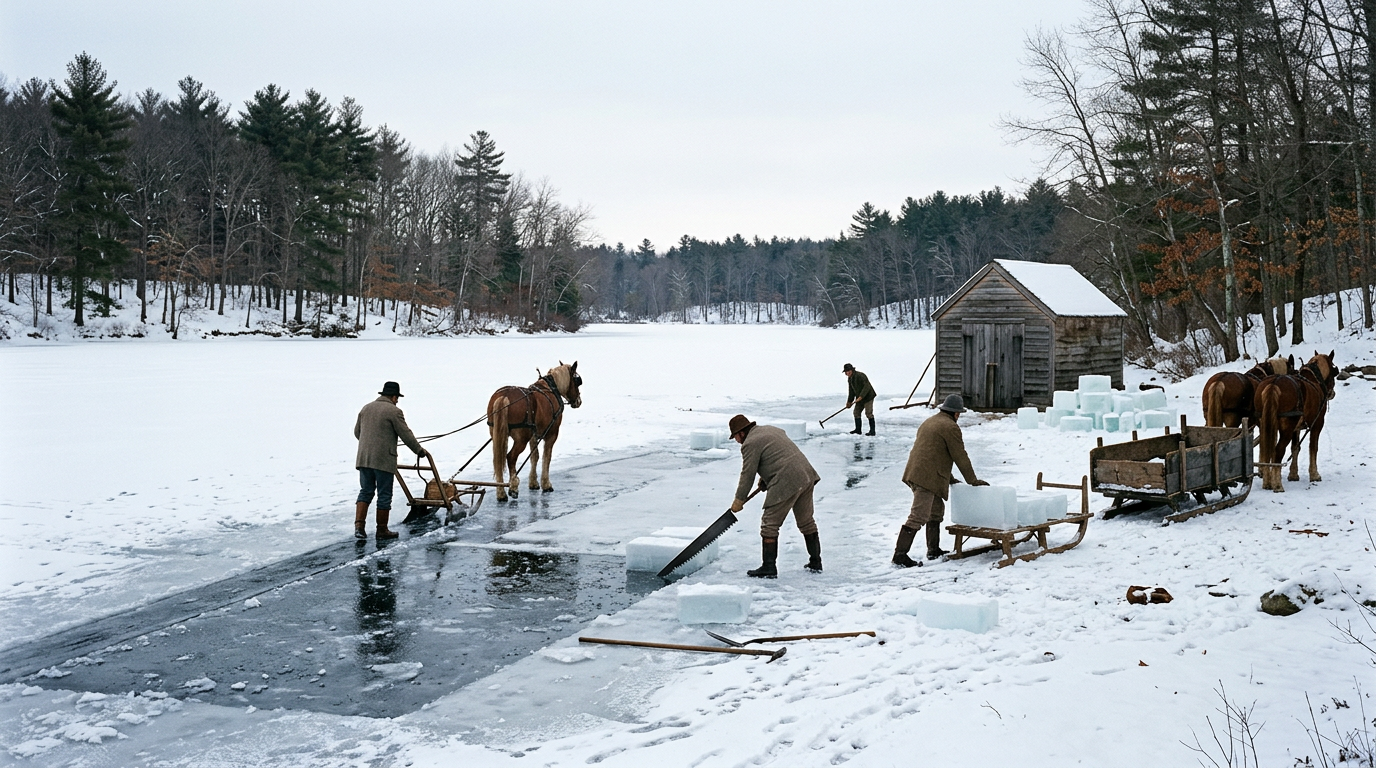
Enter Nathaniel Wyeth, a Cambridge hotelier and inventor. Wyeth developed a horse-drawn ice plow fitted with parallel iron blades that scored frozen ponds into a precise, uniform grid. Workers then used iron chisels to detach neat rectangular blocks measuring twenty-two by forty-four inches.
These uniform blocks could be stacked without gaps inside holds, dramatically reducing airflow and slowing melting rates to under eight percent on long voyages. Wyeth's mechanisation reduced harvesting costs by more than seventy percent, transforming the eponymous Tudor Ice Company into a well-oiled industrial engine. Lakes around Boston, particularly Fresh Pond and Walden Pond, became frantic commercial work sites each winter.
The four-month voyage to Calcutta
In 1833, Tudor took his greatest gamble. He loaded 180 tonnes of ice onto the ship Tuscany and dispatched it to Calcutta—a voyage of 16,000 miles that crossed the equator twice and took four months.
Anglo-Indian residents greeted the ship with astonishment. Until then, British elites in India had relied on the "hoar-frost" method: shallow terracotta pans set out on clear winter nights to collect millimetre-thin sheets of brittle ice at exorbitant expense. The Tuscany docked with more than one hundred tonnes of crystal-clear New England pond ice intact. The shipment undercut local production overnight, and Tudor secured a permanent monopoly in the subcontinent that lasted for decades.
The global ice trade eventually faded with the advent of artificial refrigeration plants in the late nineteenth century. Yet the absurd geography of cold commodities never completely disappeared; today, odd logistical quirks remain, such as the fact that Iceland imports packaged ice to supply supermarkets despite its subarctic latitude.
How to actually use this
Tudor’s triumph offers a practical case study in commercial friction and customer habit. When evaluating a new project, business venture, or workflow change, consider these three principles:
- Solve destination logistics before delivery. Tudor’s first voyage failed not at sea, but on the dock. If your customer lacks the infrastructure to retain the value of what you deliver, your product is worthless.
- Subsidise initial adoption to build reliance. Tudor gave away free ice to bars because he understood that cold drinks create an immediate sensory contrast. Find the low-cost version of your offer that demonstrates undeniable contrast to the status quo.
- Pair your asset with a complementary waste stream. Tudor could not have succeeded without sawdust, a discarded byproduct of the Maine timber industry. Look at what your current ecosystem throws away as an insulation layer for your primary work.
Related Small Talk reading
If you enjoyed this dispatch, browse today's daily Small Talk for your morning curiosity briefing, or explore more from the Small Talk blog for deep dives into economic history, linguistics, and material culture.
Frequently Asked Questions
Learn something new each day
Daily words, facts and quotes delivered to your phone.
