Quick Summary
Treating yourself as marble assumes you are an inert block that yields only to blunt force and self-inflicted pain. Living systems do not work like metamorphic rock. When you chisel aggressively at your habits or physiology, your biological defences fight back to preserve balance. True personal transformation is not extractive stone carving; it is metabolic adaptation. You cultivate conditions for organic remodelling rather than battering yourself into a brittle, unsustainable shape.
In a hurry? TL;DR
- 1Marble is dead rock; human bodies and minds are dynamic, reactive systems.
- 2Violent self-discipline triggers protective biological defences like burnout and chronic fatigue.
- 3Real change mimics cellular remodelling: continuous, small-scale, and responsive to gradual stress.
- 4Attacking perceived flaws ignores the protective functions those behaviours originally served.
- 5Lasting adaptation behaves like bone density repair or gardening, not chisel work.
- 6The romantic fantasy of suffering often disguises an inefficient, punitive approach to habit change.
Alexis Carrel won a Nobel Prize in 1912 for pioneering vascular suturing, but his widest cultural footprint rests on a single sentence of motivational violence. In his 1935 book Man, The Unknown, he wrote that man cannot remake himself without suffering, for he is "both the marble and the sculptor".
Modern fitness influencers and productivity gurus adore this line. They stencil it onto gym walls, overlay it on black-and-white photographs of classical statues, and chant it as a justification for punitive work schedules. It sounds stoic, uncompromising, and deeply heroic.
It is also terrible advice.
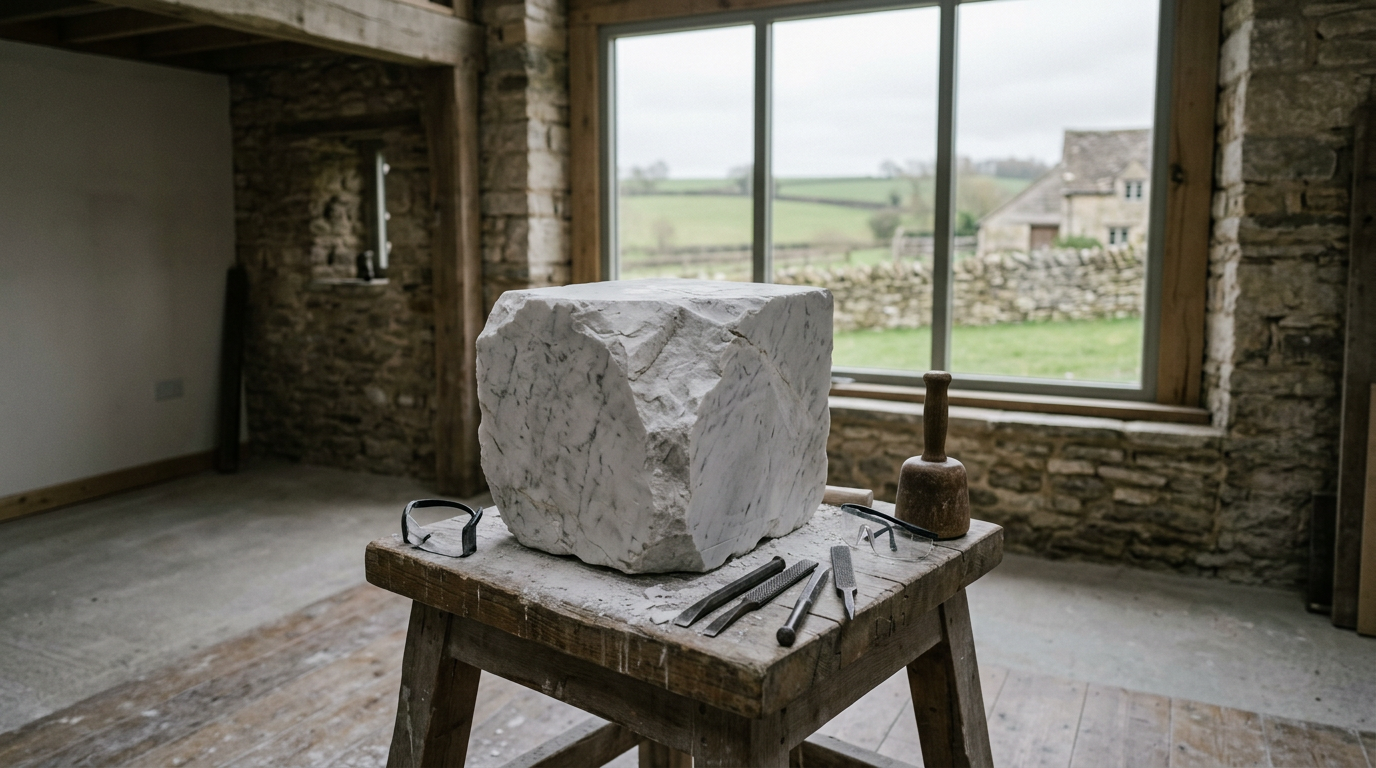
The central trouble with Carrel’s metaphor is not that genuine change is easy. The trouble is that marble is dead metamorphic rock. When a sculptor chips away at a block of Carrara stone with an iron chisel, the stone does not get inflamed. It does not deplete its glycogen stores, raise its cortisol levels, or mount an unconscious neurochemical revolt. You, on the other hand, do.
The romantic fantasy of the chisel
Carrel's image endures because it caters to an ancient human vanity: the dream of sovereign self-creation. The metaphor suggests that beneath your current, undisciplined bulk sits a pristine, muscular masterpiece waiting to be released. All that is required is enough willpower to strike the cold iron against your own soft edges.
This framework treats the self as an object of conquest. It casts your daily habits, cravings, and vulnerabilities as useless outer rubble that must be violently struck off. If the process hurts, the philosophy reassures you that the pain itself is proof of progress. Suffering becomes a moral credential rather than an operational warning sign.
Yet when people apply this logic to their actual lives, the results are depressingly predictable. They enter January resolved to hammer themselves into shape. They cut their calories by half, schedule six dawn workouts a week, and attempt to dismantle decades of coping mechanisms through sheer self-contempt. By the third week of February, the chisel has slipped, the hammer has dropped, and the marble is lying on the sofa eating crisps.
This collapse is rarely a failure of character. It is an entirely predictable biological response to an assault.
Marble does not possess a survival instinct
Unlike stone, living tissue is governed by homeostasis—the complex suite of regulatory systems designed to keep internal variables stable. When an external force attacks your current operating state too abruptly, your nervous system does not interpret the shock as self-improvement. It interprets it as famine, predation, or injury.
If you violently reduce your food intake, your body does not admire your discipline; it down-regulates thyroid activity, reduces spontaneous movement, and amplifies hunger signals. If you force yourself to work eighty hours a week through caffeine and self-recrimination, your cognitive executive function deteriorates while your emotional reactivity spikes.
The sculptor imagines he is striking stone, but he is actually striking an ecosystem. Every behaviour you possess—even the frustrating, inefficient ones—exists for a reason. Procrastination often shields you from catastrophic fear of failure. Late-night snacking might be the solitary source of soothing in an unmanageably stressful workday. When you attempt to chisel these behaviours away without addressing the structural loads they carry, the entire building shifts.
Remodelling beats extraction
If the sculptor is the wrong model for change, what is the right one? A far better blueprint comes from Carrel’s own field of physiology: the perpetual remodelling of living tissue.
Consider human bone. Bone appears rigid and permanent, much like stone, but it is in a state of unending biological negotiation. It is constantly broken down in microscopic quantities by specialised cells called osteoclasts, and rebuilt in slightly stronger configurations by osteoblasts. When placed under measured mechanical load, the bone signals for extra mineral density along the lines of stress.
Critically, this adaptation depends on two conditions: the stress must be moderate enough not to cause structural fracture, and it must be followed by adequate recovery to allow synthesis. If you hit a femur with a sledgehammer, you do not get denser bone; you get an emergency room bill.
Personal growth operates on identical terms. You cannot extract your ideal self from your current self by cutting away large pieces. You alter yourself by applying small, tolerable amounts of adaptive tension, resting adequately, and allowing your neural pathways, musculature, and psychology to remodel from the inside out.
Real change feels less like swinging a mallet and more like shedding an old skin. The old layer peels away only because a stronger, more capable one has already grown underneath it.
The quiet discipline of cultivation
Trading the chisel for biological adaptation feels unsatisfying to people addicted to dramatic narratives. The sculptor approach offers high theatre: sweat, gritted teeth, public declarations, and the intoxicating sensation of heroic martyrdom. Biological remodelling looks quiet, repetitive, and deeply unglamorous. It looks like going to bed thirty minutes earlier, taking a ten-minute walk after lunch, or writing two bad paragraphs every morning before opening email.
Carrel was partially right about one thing: change does involve discomfort. Expanding your capacity requires you to bump up against unfamiliar boundaries. But that friction is not the extractive agony of carving off parts of yourself. It is the stretching tension of growth.
When you stop viewing yourself as inert rock, you stop needing to punish yourself into competence. You stop trying to be the sculptor who treats his own body as collateral damage. You become the steward of a living organism that adapts willingly, provided you give it the right stimulus and the grace to repair.
How to actually use this
- Calibrate the dose below the panic threshold. When adopting a new habit, pick a version that creates mild adaptation rather than systemic shock. If thirty minutes of daily study triggers avoidance, study for eight minutes. The goal is tissue adaptation, not exhaustion.
- Audit the function before removing the form. Before you attempt to eliminate a bad habit, ask what psychological job it performs. If scrolling your phone at night relieves loneliness, substitute another low-friction connection, not sterile deprivation.
- Treat recovery as an active building phase. Bone remodels during rest, not during the lift. If your improvement programme does not include scheduled, protected recovery, you are fracturing stone, not building resilience.
- Measure consistency over intensity. A sculptor can finish a statue in a frantic two-week sprint. An organism cannot remodel its biology overnight. Give adaptive inputs three months of quiet repetition before deciding whether the protocol works.
Related Small Talk reading
- Read the original text and context of "both the marble and the sculptor".
- Explore how biological systems preserve stability in our deep dive on homeostasis.
- Discover why your skeleton is never finished in our exploration of the remodelling of living tissue.
- Reframe personal transition through Joseph Campbell's perspective on shedding an old skin.
*Keep feeding your curiosity: read today's daily Small Talk or discover more from the Small Talk blog.*
Frequently Asked Questions
Learn something new each day
Daily words, facts and quotes delivered to your phone.
