Quick Summary
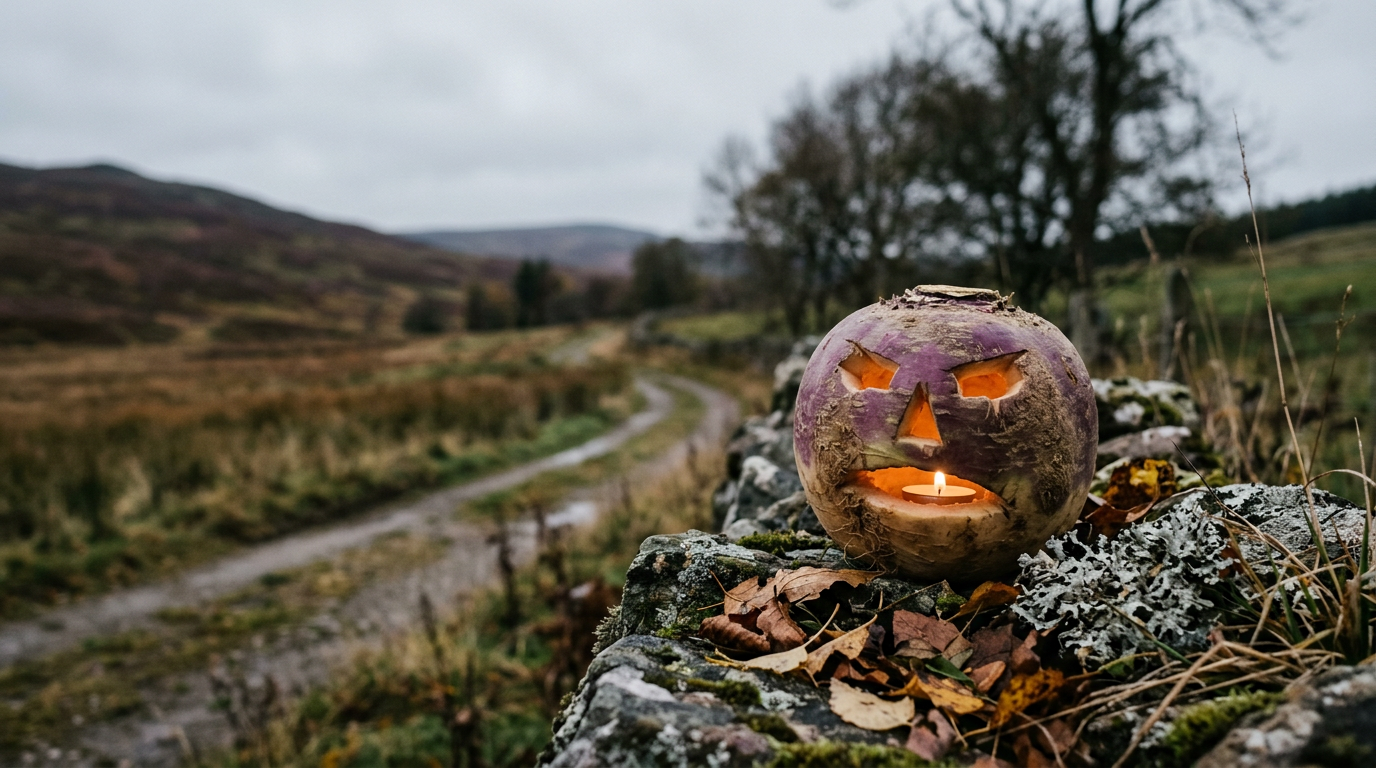
Turnips, mangelwurzels, and swedes were hollowed out across Ireland, Scotland, and northern England for the Gaelic festival of Samhain. Placed on gateposts with glowing embers inside, their grotesque, desiccated faces were intended to ward off malevolent spirits and mimic wandering souls like Stingy Jack. When Irish and Scottish emigrants arrived in North America in the nineteenth century, they discovered pumpkins, which were vastly softer, larger, and far easier to carve than fibrous native roots.
In a hurry? TL;DR
- 1Turnip lanterns originated with the Celtic festival of Samhain to repel roaming spirits
- 2Carving a traditional brassica was brutal, blister-inducing domestic labour
- 3The legendary figure of Stingy Jack gave rise to the term 'Jack-o'-lantern'
- 4A dried turnip lantern shrinks into a genuinely horrific, mummified visage
- 5Nineteenth-century transatlantic emigration introduced carvers to the accommodating native squash
- 6The modern cheerful pumpkin replaced an older, grimmer apotropaic ritual
If you have ever tried to hollow out a raw purple-top turnip with a kitchen spoon, you will understand why the modern pumpkin won the cultural war. Carving a turnip is not a cosy family craft. It is a slow, wrist-cracking battle against dense, fibrous cellulose that smells faintly of cold cabbage and damp earth.
Yet for centuries across Ireland, Scotland, the Isle of Man, and northern England, that obstinate root was the standard late-October sentinel. Long before glossy orange gourds colonised suburban doorsteps, households spent the tail end of the harvest scraping out bitter flesh to make miniature lanterns.
These were not designed to be whimsical or photogenic. Lit by tallow candles or burning embers, their pale, gnarled skins shrivelled within days into grimacing, sunken skulls. The goal was never to charm the neighbours. It was to terrify the things that lurked in the dark.
The threshold of Samhain
The tradition belongs firmly to the Gaelic festival of Samhain, marking the end of the harvest and the seasonal shift into autumn as dark, barren winter arrived. In Gaelic cosmology, this was a liminal boundary when the veil separating the physical world from the Otherworld grew dangerously thin.
During this interlude, the Aos Sí—spirits, fairies, and unquiet dead—could wander into mortal settlements. The rural population did not romanticise this prospect. Wandering spirits brought misfortune, ruined livestock, and snatched unwary travellers into the bogs. To protect the homestead, people engaged in apotropaic magic: rituals designed to deflect evil.
Carving a grotesque face into a root vegetable served a dual purpose. It could frighten off lingering spectres by presenting them with an equally horrifying image, or it could disguise the bearer as a fellow wandering shade. These lanterns, often called tumshie lanterns in Scotland or punkies in Somerset (where large mangelwurzels were favoured), stood guard on gateposts and stone walls, casting sickly yellow shadows across the lane.
The legend of the wandering smith
Behind the physical object lies an older folk tale that explains the term 'Jack-o'-lantern'. While modern culture has an appetite for borrowing ancient mythology to name products and algorithms, nineteenth-century villagers used folklore to explain genuine dread.
The story centres on Stingy Jack, a cunning, miserly blacksmith who managed to outwit the Devil not once, but twice. In the most common tellings, Jack invited the Devil for a drink and convinced him to turn into a sixpence to pay the tavern bill. Jack then pocketed the coin next to a silver crucifix, trapping the Devil until he promised not to claim Jack's soul for a decade.
Years later, Jack tricked the Devil into climbing an apple tree to fetch fruit, quickly carving crosses into the bark to strand him in the branches. When Jack finally died, heaven refused entry to such a deceitful scoundrel, and the Devil, keeping his promise, barred him from hell. Condemned to roam the freezing darkness between worlds for eternity, Jack was tossed a single burning ember from the fires of the pit. He hollowed out a turnip he had been chewing, placed the ember inside, and set off on his endless wander.
Irish folklore referred to this wandering apparition as 'Jack of the Lantern', which gradually compressed into 'Jack-o'-lantern'. The term had originally described will-o'-the-wisps, those eerie atmospheric tricks of light caused by combusting marsh gas over peat bogs. The vegetable carving became the earthly re-enactment of Jack’s tragic exile.
Anatomy of an old-world lantern
Tracing the lexical roots of household rituals reveals how deeply practical domestic objects shaped superstition. The tools required to construct a turnip lantern were whatever lay in an ordinary scullery: an iron paring knife, a sturdy spoon, and sheer persistence.
The vegetable in question was typically a swede (Brassica napus) or a turnip (Brassica rapa). Because the flesh is tightly packed and contains very little free water compared to a squash, excavating the interior required gouging out small, hard shavings. Children often had sore palms for days afterwards.
Once hollowed, the carver cut crude slits for eyes and a jagged mouth. There was no attempt at architectural precision. Because the skin was tough, straight, slicing cuts were the only practical option. The result was severe and angular: triangular sockets, slit noses, and grim lines of squared teeth.
When a tallow candle burned inside, the heat roasted the raw brassica flesh, giving off a sharp, pungent, slightly sulfurous odour. As the root dried out over forty-eight hours, the skin shrank and puckered around the carved apertures. The face did not rot gracefully; it tightened into an authentic memento mori that looked startlingly like an exhumed corpse.
The transatlantic upgrade
The pivot from turnip to pumpkin occurred in the mid-nineteenth century, driven by tragedy and migration. Following the Great Famine in Ireland, hundreds of thousands of Irish and Highland Scottish families emigrated to North America, bringing their Samhain customs with them.
Upon arriving in the New World, they encountered Cucurbita pepo—the native North American pumpkin. For an exhausted parent trying to maintain a homeland tradition for their children, the pumpkin was a revelation.
Unlike the stubborn British swede, a ripe pumpkin has a soft, pulpy cavity filled with loose seeds that can be scooped out in seconds with bare hands. Its outer walls yield easily to ordinary blades, permitting intricate, curved cuts and expressive features. Furthermore, its generous dimensions made it far more visible from the road, while its warm orange hue transformed an object of dread into one of autumnal abundance.
By the early twentieth century, American retail culture and children's literature had institutionalised the pumpkin lantern. When American Halloween imagery was exported back across the Atlantic in the late twentieth century, British and Irish households gladly abandoned the turnip. Nostalgia was no match for mechanical convenience.
How to actually use this
You do not need to abandon pumpkins entirely to appreciate the history, but understanding the root tradition changes how you view the season:
- Try carving a single turnip once. Take a medium swede, slice off the crown, and hollow it out. It takes four times longer than a pumpkin and smells entirely different, but the shrivelled result after three days will give you an immediate appreciation for historical horror.
- Look beyond doorstep decorations. The original custom was grounded in apotropaic protection, not commercial celebration. Treating seasonal rituals as historical preservation helps ground our modern consumption in genuine agrarian heritage.
- Appreciate the migration of foodways. The pumpkin's triumph is a classic study in cultural adaptation: immigrants keeping an ancient intangible belief alive by adopting whatever local botany makes life easier.
Related Small Talk reading
- Read about the seasonal shift into autumn and how harvest cycles shaped our collective calendar.
- Explore the lexical roots of household rituals to discover how domestic words outlived the tools that created them.
- Investigate the atmospheric tricks of light that convinced our ancestors the peat bogs were inhabited by restless wandering souls.
- Learn why modern culture keeps borrowing ancient mythology to package modern obsessions.
*Dig into the origins of everyday customs with today's daily Small Talk, delivered every morning.*
Frequently Asked Questions
Learn something new each day
Daily words, facts and quotes delivered to your phone.
