Quick Summary
Digital payment terminals do not just process cards; they engineer social pressure. When software pairs gratuity requests with bright colours, anthropomorphic illustrations, or smiling emojis, it triggers reciprocal social instincts designed for human interaction. Because our brains instinctively treat friendly facial cues as relational gestures rather than commercial tactics, we tip more to avoid feeling stingy or cold, transforming a cold piece of hardware into a high-pressure social encounter.
In a hurry? TL;DR
- 1Software designers use affective micro-nudges to make card terminals feel friendly.
- 2Smiling icons and warm colours trigger ancient reciprocal social obligations.
- 3Time pressure at the counter turns deliberate financial decisions into reflexive compliance.
- 4Default tip percentages are set higher because simulated warmth softens price sensitivity.
- 5Separating genuine service gratitude from interface guilt saves significant money over time.
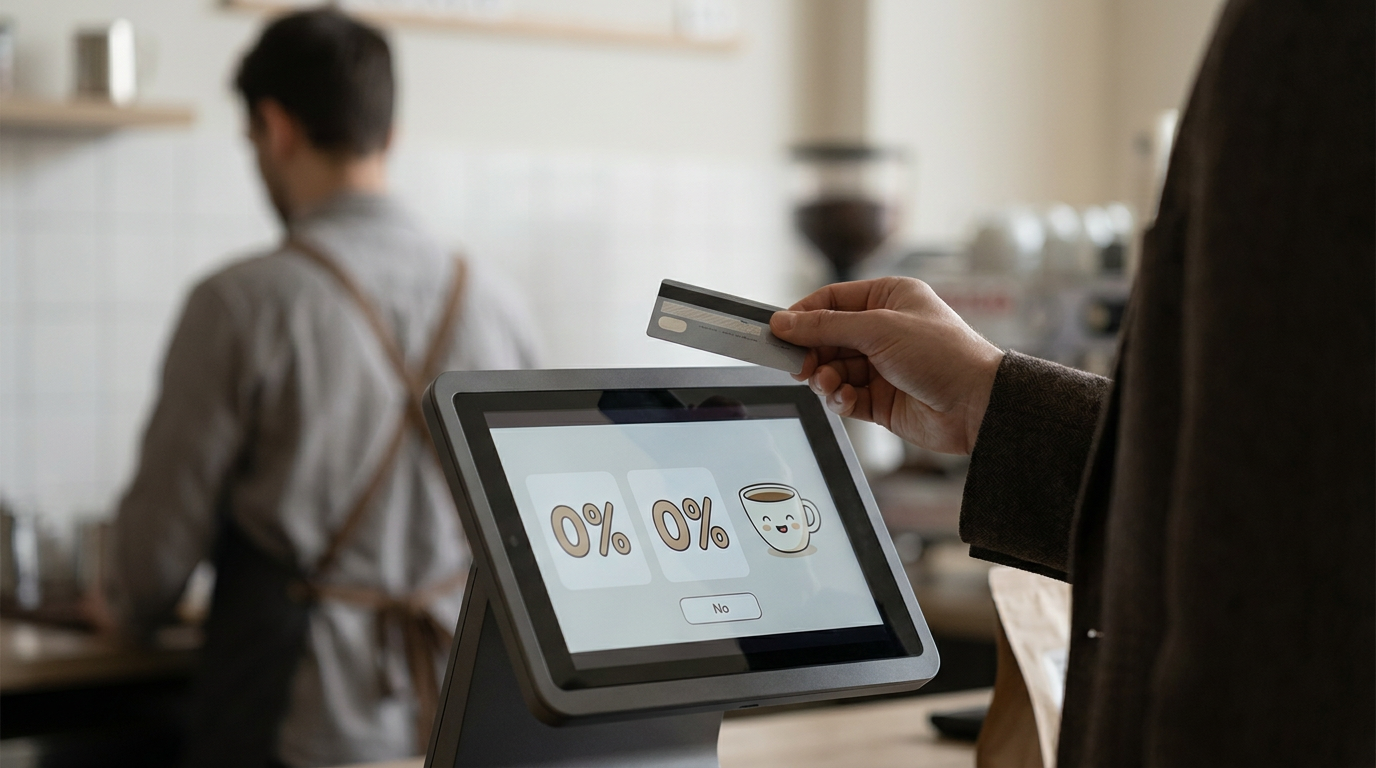
You order an ordinary filter coffee. It costs £3.40. The barista turns a sleek touchscreen terminal towards you, and before you can tap your card, the screen blooms into life. Alongside three preset tip options—starting at an audacious 20 per cent—sits a bouncing cartoon coffee cup with a wide, friendly grin.
There is no human coercion happening here. The person behind the counter may already have turned their back to steam milk. Yet in that brief, awkward pause, your thumb hovers. Pressing 'No Tip' suddenly feels like slapping away an outstretched hand. You tap 15 per cent, pay £3.91, and walk out slightly annoyed with yourself.
This is not accidental interface design. It is the calculated deployment of affective micro-nudges, engineered to exploit human social wiring for commercial gain.
The Architecture of Artificial Warmth
For decades, commercial transactions were deliberately neutral. A card reader was an austere block of grey plastic that beeped, approved, and spat out a receipt. It had no personality because machines were not expected to have one.
The modern point-of-sale terminal is different. It is a full-colour tablet equipped with dynamic software that understands behavioural psychology better than most consumers do. Designers have discovered that emotional priming changes how people value money in real time. A sterile interface invites calculation; a cheerful interface invites cooperation.
Recent data confirms the efficacy of these subtle additions. In controlled hospitality environments, researchers noted that adding smiley-face emojis to tipping prompts significantly increased the average gratuity given by customers who were otherwise paying for counter-only service. The emoji costs nothing to render, yet it reliably yields higher revenue by manufacturing an illusion of warmth.
Why Your Social Brain Cannot Tell the Difference
Human beings evolved in small, interdependent groups where social rejection carried existential danger. We survived by developing acute sensitivity to facial expressions, tone of voice, and reciprocal gestures. When an ally smiled at us, we returned goodwill. It was the fundamental currency of human cohesion.
Your neurobiology cannot effortlessly distinguish between a living human smiling in gratitude and an animated face smiling from an LCD screen. The stimulus enters the visual cortex and lights up the same emotional circuitry. Even when you consciously know the device is a mass-produced piece of glass and silicon, your intuitive subconscious reacts as though it has been engaged in a social relationship.
Refusing to tip a machine that appears pleased to see you triggers an infinitesimal spike of social discomfort. It feels impolite. Payment platforms bank on that specific discomfort. By replacing neutral typography with anthropomorphic charm, they transform an objective commercial exchange into an emotional trial.
Speed, Guilt, and Manufactured Defaults
Simulated warmth is only half the trap. The other half is velocity. Point-of-sale encounters happen in public, with a queue of impatient commuters behind you and a cashier within arm's reach.
In classical rhetoric and behavioural studies, hesitation and indecision are known to compound anxiety under social scrutiny. When a terminal presents four options—three cheerful percentages and one tiny, pale 'custom' or 'skip' button—the cognitive cost of opting out rises sharply. To decline the prompt requires reading the screen carefully, locating the less prominent button, and pressing it under the gaze of others.
Compliance, by contrast, is a single tap on a large, brightly coloured button. It resolves the tension immediately. The smiling graphic provides instant positive reinforcement, reassuring you that you are a decent, generous person who belongs in polite society.
Over the course of a week, paying an extra 50p or £1 on takeaway items feels negligible. Over months, however, these engineered emotional concessions represent how small leaks accumulate over time, quietly diverting substantial sums of money from your pocket into corporate payment margins and inflated service figures.
Separating Gratitude from Interface Coercion
Tipping was originally conceived as an organic expression of gratitude for attentive, personal service. It was a voluntary human transaction that acknowledged effort above and beyond basic duty.
What modern screens demand is not gratitude; it is compliance disguised as manners. When a software platform prompts you for a tip before any service has been rendered—or in situations where no service beyond handing over a pastry has occurred—it is using emotional mimicry to extract an arbitrary price increase.
Recognising the difference between genuine human empathy and simulated software friendliness is the first step towards reclaiming your agency at the till.
How to actually use this
To keep your spending deliberate and your generosity authentic, adopt a few simple rules next time a payment screen spins your way:
- Implement the counter rule. If you order standing up and take your own food or drink away, the baseline tip is zero. Reserve gratuities for seated table service, complex deliveries, or personal assistance that genuinely warrants recognition.
- Pause for two full seconds. The software relies on rushed embarrassment. Take a deliberate breath, read the screen, and locate the 'No Tip' or 'Skip' button without apologising.
- De-personalise the screen. Mentally remind yourself: A graphic designer in California drew that smile to inflate transaction fees. It is code, not a person.
- Reward humans directly. If a barista or server provided exceptional hospitality, consider carrying a few coins or explicitly thanking them with words rather than capitulating to an automated prompt.
Related Small Talk reading
Explore more behavioural dynamics behind everyday decisions:
- Learn about the mechanics of emotional priming and how environments subtly dictate our choices.
- Read the research behind adding smiley-face emojis to tipping prompts in modern point-of-sale design.
- Reflect on how hesitation and indecision leave us vulnerable to conversational and financial pressure.
- Understand how small leaks accumulate over time across personal balance sheets.
*Sharpen your critical eye every morning with today's daily Small Talk, delivering concise insights on psychology, language, and culture directly to your pocket.*
Frequently Asked Questions
Learn something new each day
Daily words, facts and quotes delivered to your phone.
