Quick Summary
This week examined how physical reality routinely defies human intuition. The summit of Mount Everest consists of Ordovician limestone formed on a prehistoric sea floor; nineteenth-century merchants turned Massachusetts pond ice into a global trade empire; human bone quietly dismantles and reconstructs itself every decade; and modern workers systematically sabotage deep work by chasing trivial admin. Here is the connective tissue between them.
In a hurry? TL;DR
- 1Everest's summit is Ordovician limestone formed beneath an ancient ocean.
- 2Frederic Tudor built an international trade network shipping insulated pond ice.
- 3The human skeleton constantly breaks down and rebuilds its mineral architecture.
- 4Urgency bias tricks our brains into choosing trivial tasks over consequential work.
- 5Physical structures and cognitive habits are rarely as static as they appear.
If you spent the week keeping your head down, you might have missed the underlying pattern running through our dispatches: things that seem permanently fixed are usually in mid-transit.
Take the highest point on the planet, which spent hundreds of millions of years at the bottom of a tropical sea before plate tectonics hoisted it nearly nine kilometres into the sky. Or consider the ice in a summer gin and tonic, which was once an impossibly risky cargo hauled across the equator in the hold of a wooden brig. Even the hard calcium cage inside your chest is currently taking itself apart and rebuilding from scratch.
Here is our brisk Sunday look back at the ideas, oddities, and historical calculations that anchored this week's discussions, along with a few ways to use them before Monday morning resets the board.
Inversions in Stone: Marine Life at 8,848 Metres
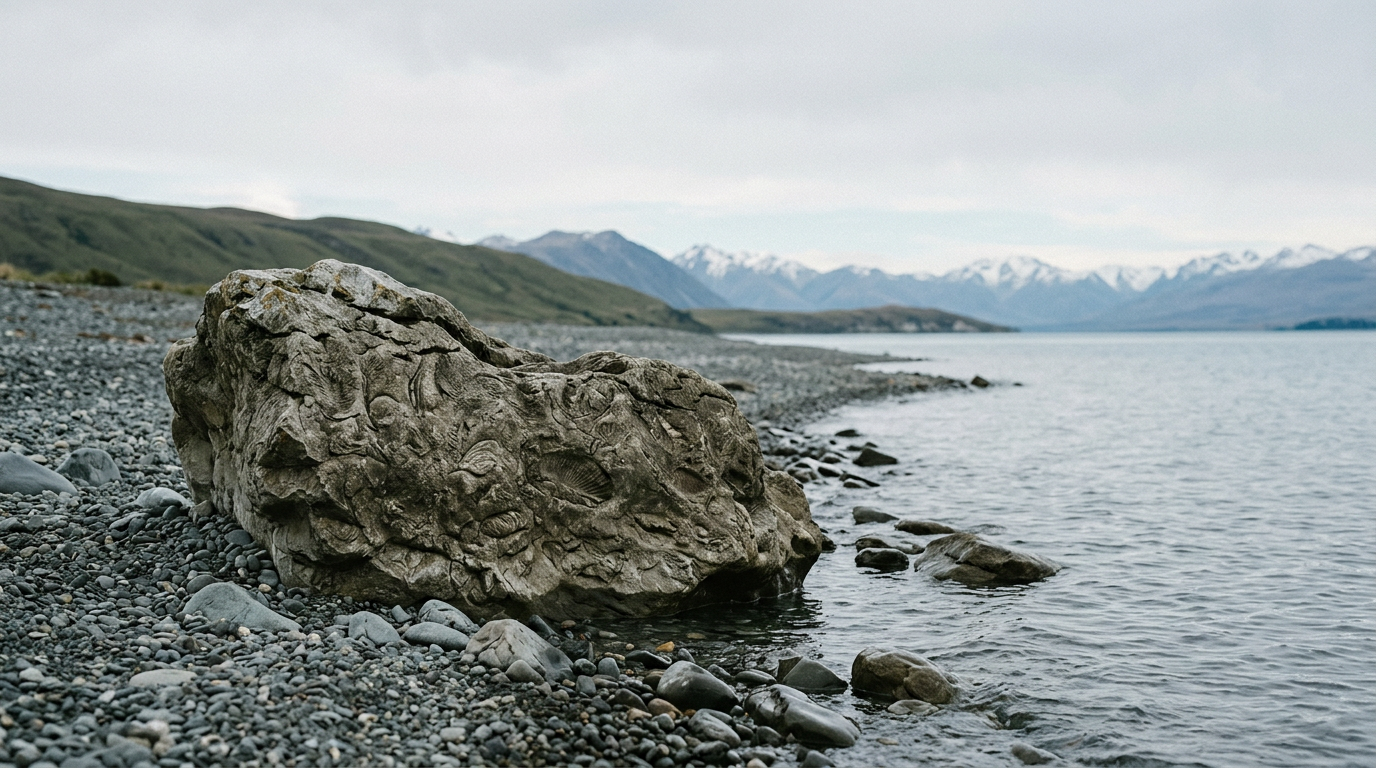
Climbers who reach the crest of the world are standing on the Yellow Band, a distinct layer of Qomolangma limestone. That rock is not volcanic basalt or deep-mantle granite. It is the compressed detritus of marine invertebrates, trilobites, and crinoid stems that drifted to the floor of the Tethys Ocean roughly 450 million years ago.
When the Indian plate slammed into Eurasia some fifty million years back, the ocean between them had nowhere to go but down into the mantle or up into the air. The resulting collision buckled the seabed, thrusting marine strata higher than any other continental rock on Earth. As we noted when examining the ancient sea floor atop Mount Everest, the mountain is less a permanent monument than an ongoing geological accident. It is still rising at roughly four millimetres a year, even while weathering strips the fossils away grain by grain.
It is a neat reminder that permanence in nature is simply a matter of timescale. The hardest mountain under foot was once sea silt, and the seabed of today is merely mountain timber in waiting.
The Commercial Madness of Shipping Ice
From rock formed under water to water turned to rock. In the early nineteenth century, a Boston merchant named Frederic Tudor looked at frozen New England ponds during winter and decided to sell them to the Caribbean. His contemporaries treated the plan as lunacy, assuming the cargo would dissolve into bilge water within forty-eight hours of hitting Gulf Stream temperatures.
Tudor persisted through bankruptcy, debtor's prison, and immense technical failure until he cracked the physics of thermal insulation. By packing cut pond blocks tightly in pine sawdust within double-walled wooden hulls, he proved that ice could travel sixteen thousand kilometres across the equator with less than ten percent melt.
Our deep dive into how Boston shipped lake ice across the globe showed how that single insight created an entire international supply chain. Ships that once carried cheap ballast to Havana or Calcutta were suddenly laden with Wenham Lake ice, changing medical care, meat preservation, and drinking habits in tropical outposts decades before artificial refrigeration was commercially viable. What looked like absurd logistics was simply an arbitrage between different climates and cheap industrial waste.
The Living Scaffold
While Tudor was moving solid water across oceans, your own internal framework was busy moving itself. We tend to view the human skeleton as an architectural fixture: a finished scaffold installed in our twenties that slowly weathers with age, like the timbers of an old barn.
In reality, bone is one of the most metabolically active tissues in the body. Two opposing cellular populations work in continuous tension. Osteoclasts bore microscopic tunnels through mechanical stress points, dissolving aged, brittle bone mineral. Immediately behind them, osteoblasts lay down fresh collagen and calcium crystals to patch the path. Because of this continuous remodelling cycle, your body replaces its own skeleton every decade.
The ribs protecting your lungs today are not the ribs you possessed ten years ago; they are an exact, newly manufactured replacement tailored to the precise mechanical loads you placed upon them during the intervening decade. You are not wearing a suit of bones. You are maintaining an active construction site.
The Cognitive Glitch: Mistaking Motion for Progress
If our bones and mountains remodel themselves out of mechanical necessity, our work habits often remodel themselves out of self-defence. Later in the week, we turned our focus inward to the psychological quirk known as urgency bias: our persistent, irrational habit of clearing trivial errands instead of deep work.
When faced with an open calendar, the brain naturally gravitates toward tasks with tight deadlines and negligible stakes (replying to brief emails, adjusting a spreadsheet, tidying a desktop) over high-leverage projects that require sustained cognitive strain. Completing a trivial task triggers an immediate dopamine dividend. Tackling an ambiguous, high-value problem offers only the threat of failure and sustained mental fatigue.
The consequence is a modern paradox: an exhausting eight-hour day of unrelenting activity that leaves long-term goals completely untouched. Understanding that our brains naturally mistake speed for consequence is the first step toward declining the bait.
How to actually use this
Sunday reading is useless if it stays trapped in an armchair. Here are three simple applications for the week ahead:
- Audit your first hour: Before opening your inbox on Monday morning, identify one consequential project and work on it for forty-five minutes without interruption. Deny your brain the cheap dopamine hit of clearing tiny administrative tasks first.
- Reframe physical limits: If you are building strength or recovering from strain, remember bone remodelling requires mechanical load. The skeleton adapts precisely to the forces applied to it; without regular resistance, osteoclasts outpace osteoblasts.
- Sharpen your conversation: The next time a dinner table conversation turns to Everest, skip the standard climbing tropes. Ask whether anyone knows why the highest rock on the planet is packed with fossilised sea sponges.
Related Small Talk reading
If you want to explore the source material behind this week's roundup, start with our breakdown of the ancient sea floor atop Mount Everest, which details the Ordovician marine strata at the summit. Follow that with the bizarre commercial history of how Boston shipped lake ice across the globe.
For practical thinking, review the biological mechanics of how your body replaces its own skeleton every decade, or examine the cognitive study on clearing trivial errands instead of deep work. If you are looking for fresh ideas tomorrow, check today's daily Small Talk to begin the new week with a sharper lens on the world.
Frequently Asked Questions
Learn something new each day
Daily words, facts and quotes delivered to your phone.
