Quick Summary
Cells solve the knotting problem through hierarchical spooling and a specific geometry called a fractal globule. DNA first wraps around spools of histone proteins, creating beads-on-a-string called nucleosomes. Motor proteins then pinch these strands into loops, which condense into dense chromatin domains. Crucially, the chain folds upon itself without knotting or threading: any segment can quickly unravel when transcription enzymes need access, then fold back neatly without snagging neighbouring strands.
In a hurry? TL;DR
- 1Each human cell nucleus packs roughly two metres of DNA into six micrometres.
- 2DNA wraps around octamers of histone proteins to form nucleosomes.
- 3Cohesin and condensin rings extrude chromatin into insulated loops.
- 4Rather than an equilibrium knot, the genome forms an unknotted fractal globule.
- 5Unspooling happens locally on demand without disturbing adjacent regions.
- 6Failures in this spatial origami cause chromosomal damage and disease.
If you stretched out the double-stranded thread of DNA contained within a single human nucleus, it would measure approximately two metres from end to end. The container housing it, however, is a cellular sphere roughly six micrometres across—a space so narrow that a human hair is twelve times thicker.
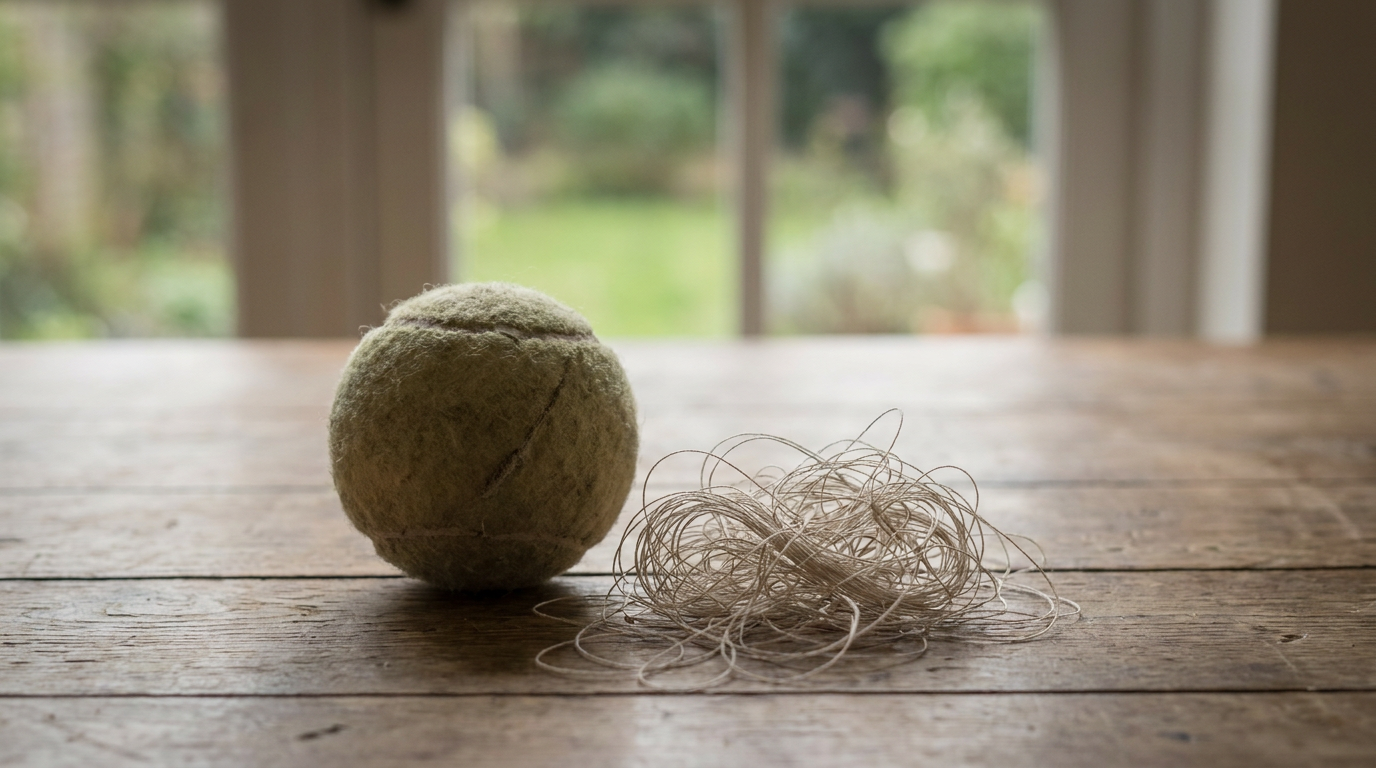
To appreciate what that means in human terms, imagine taking forty kilometres of exceptionally fine, fragile sewing thread and packing it into a tennis ball. Now add an impossible requirement: you must be able to locate, pull out, copy, and replace any ten-centimetre segment of that thread in a fraction of a second, thousands of times an hour, without ever catching a snag or pulling a knot.
Left to ordinary physics, long polymers in tight containers turn into a hopeless tangle. Yet your cells pull off this feat continuously across trillions of sites in your body. The solution is not brute compression, but a masterclass in hierarchical origami.
The Physics of a Storage Crisis
The fundamental obstacle is entropy. A long, flexible polymer confined within a tight space will naturally explore every available conformation until it settles into an equilibrium state. In simple terms, it knots itself. If genomic DNA were allowed to drift into an equilibrium tangle, the molecular machines responsible for reading genes would stall almost instantly. An enzyme attempting to travel along a knotted strand would cause catastrophic tension, snapping the delicate phosphate backbone.
To prevent this, the cell relies on an active, multi-tiered architecture that begins the moment DNA is replicated. Packing two metres of DNA into an envelope mere millionths of a metre wide demands a volume reduction factor of roughly ten thousand to one.
Achieving this degree of extreme compaction requires the cell to treat genetic code not as loose string, but as structural timber, wrapping, looping, and compartmentalising the strand at distinct physical scales.
Stage One: The Histone Spool
The foundational unit of compaction is the nucleosome. If you looked at an unfolded chromosome under an electron microscope, you would see what looks like beads on a string. Those beads are protein complexes made of histones.
Histone proteins carry a strong positive electrical charge, derived from abundant lysine and arginine residues. The phosphate backbone of DNA, by contrast, carries a dense negative charge. This electrostatic attraction causes DNA to wrap snugly around a core of eight histone proteins—an octamer—like thread around an empty bobbin.
Each nucleosome spool takes in exactly 147 base pairs of DNA, wrapping them 1.65 times around the histone core. Between each spool lies a short linker sequence of free DNA. This first step alone shrinks the length of the genetic strand by a factor of roughly six. It also neutralises much of the negative charge that would otherwise cause different stretches of DNA to repel one another violently when forced into close quarters.
Stage Two: Loops and Extrusion Motors
Spools on their own are not enough. If you leave a string of beads loose in a jar, it will still snarl. The cell’s next layer of control involves active mechanical engineering, driven by molecular motors called cohesin and condensin.
These protein complexes resemble tiny molecular rings. They latch onto the chromatin strand and burn ATP to reel the thread through themselves, extruding dynamic loops. As the ring works, the loop grows larger until the motor hits an architectural stop sign: a bound protein called CTCF.
By anchoring loops at specific boundaries, these extrusion motors partition the genome into thousands of self-contained neighbourhood units known as Topologically Associating Domains (TADs). Inside a single TAD, genes and their regulatory switches can bump into each other freely. Crucially, they are physically barred from tangling with the DNA of neighbouring domains. The cell operates less like a junk drawer and more like a series of meticulously cable-tied server racks.
Why It Doesn't Knot: The Fractal Globule
For decades, polymer physicists struggled to explain how DNA could be packed so densely while remaining instantly accessible. In 1988, theoretical physicists proposed that polymers could, in theory, pack into an unusual configuration called a 'fractal globule'.
In standard polymer tangles—known as equilibrium globules—the thread meanders randomly, threading through loops and tying itself into knots like a plate of wet spaghetti. If you pull on one strand of spaghetti, the whole plate shifts, and the knot tightens. In a fractal globule, by contrast, the polymer folds through successive crumples at different scales: small regions collapse into small crumples, which then pack together into larger crumples, without any strand ever passing through another.
In 2009, researchers using a technique called Hi-C—which maps every point where DNA touches itself inside the nucleus—confirmed that the human genome conforms precisely to this fractal model. Our understanding of this microscopic architecture matches what researchers discovered when they first developed methods for seeing inside living tissue: nature invariably favours structural elegance over chaotic density.
Because the DNA is crumpled rather than knitted, it has zero knots. Any segment can be pushed out from the mass, transcribed into messenger RNA, and pulled back in without disturbing the surrounding geometry. It is the molecular equivalent of crumpling a sheet of paper rather than balling up wet string.
Unpacking on Demand: The Epigenetic Ledger
A static filing system is useless if you cannot open the folders. Cells keep certain genes permanently sealed and others perpetually available using an chemical indexing system.
Enzymes known as histone acetyltransferases attach small acetyl groups to the tails of histone proteins. This chemical cap neutralises the histone's positive charge, weakening its grip on the DNA backbone. The spools loosen, sliding along the strand and exposing the underlying genetic letters to transcriptional machinery. When the gene is done being read, deacetylase enzymes remove the tags, and the spool locks tight once more.
When this architecture fails—whether through mutated CTCF anchors or broken histone markers—the consequences are immediate. Unspooled genes turn on inappropriately, or regulatory switches strike the wrong targets, a hallmark of several aggressive cancers.
How to actually use this
Understanding how your cells package information offers a useful mental model for handling complex systems:
- Separate storage from indexing: The genome does not sort information chronologically; it clusters functional neighbourhoods using physical loops (TADs). When organising dense archives or projects, partition related components into closed loops that cannot cross-contaminate.
- Avoid the equilibrium trap: Any flexible system left to random accumulation will knot itself. Order is an active, energy-consuming process. The cell spends ATP continuously via loop-extruding motors just to maintain physical accessibility.
- Think in fractal layers: When designing deep documentation or file structures, build modules that can expand or contract independently without requiring changes to adjacent folders.
Related Small Talk reading
Explore more strange mechanics and natural architecture across our library:
- Read the original measurement of two metres of DNA inside human cells.
- Learn about the physics of extreme compaction in natural structures.
- Explore the history of seeing inside living tissue.
- Investigate how natural chalk preserves microscopic architecture.
- Catch up on today's daily Small Talk or browse more from the Small Talk blog.
*Discover one sharp, surprising daily insight every morning with the Small Talk app.*
Frequently Asked Questions
Learn something new each day
Daily words, facts and quotes delivered to your phone.
