Quick Summary
A meditation on age, antiquity, and why ancient things carry emotional force.
Humans struggle to internalise deep time. We measure our lives in decades and our history in centuries, yet the world operates on a scale that makes a human lifetime look like a camera flash in a dark room.
- Chronological displacement: Why our brains struggle to map events that happen across different eras.
- Living relics: How biological organisms like trees and sharks outlast entire civilisations.
- Astronomical weight: The physical reality of objects like a neutron star teaspoon weighs 6 billion tons and how they bend our understanding of matter.
- Prehistoric overlaps: Surprising moments where ancient history was closer to the modern day than we realise.
- Digital immortality: The shift from stone tablets to storing digital data in DNA to preserve our history for millennia.
The way we perceive history is often flawed by "the chronological effect," where we assume ancient events happened roughly at the same time, despite being separated by thousands of years.
The Overlapping Eras of History
We tend to think of history in distinct chapters: the Stone Age, Ancient Egypt, the Roman Empire, the Industrial Revolution. In reality, these chapters bleed into one another in ways that feel impossible.
Take the woolly mammoth. Most people associate these tusked giants with the deep Ice Age. However, while the Great Pyramid of Giza was being constructed in Egypt, a small population of woolly mammoths was still roaming Wrangel Island in the Arctic Ocean. They didn't go extinct until roughly 1650 BCE.
This means that as humans were developing complex mathematics and early writing systems, creatures from the Pleistocene were still breathing. This kind of overlap creates a sensory glitch. It challenges the idea that history is a straight line of progress, suggesting instead a world where the prehistoric and the "modern" frequently coexist.
Biological Time Travellers
While we worry about our daily schedules, some organisms are playing a much longer game. In the cold waters of the North Atlantic, the Greenland shark can live for over 400 years. Some individuals currently swimming in the ocean were likely alive when the Mayflower set sail.
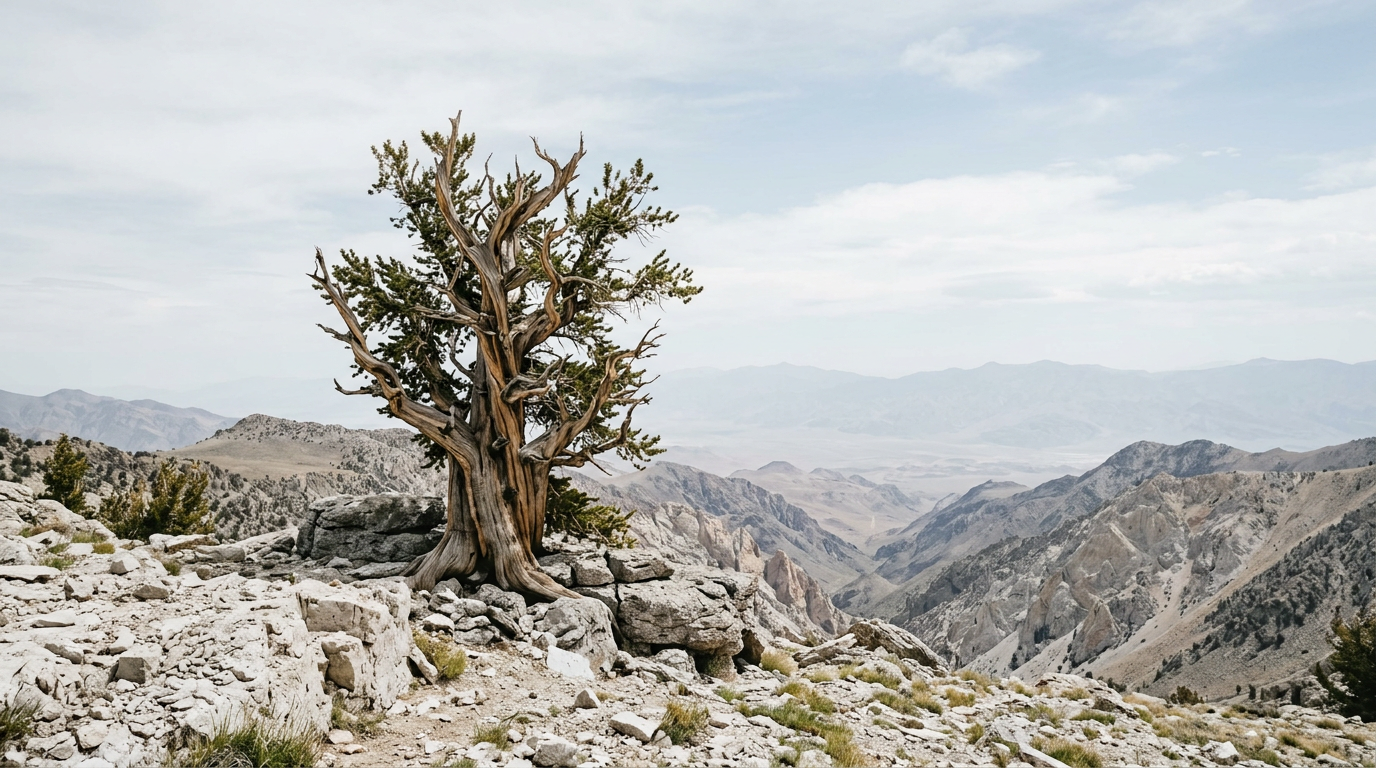
Plants take this endurance even further. In the White Mountains of California, a Great Basin bristlecone pine named Methuselah has been growing for over 4,800 years. It was already an ancient tree when Rome was just a collection of huts by the Tiber.
These living things represent a bridge to a past we can only otherwise access through archaeology. They have witnessed the rise and fall of empires not as historical data, but as climate shifts recorded in their rings or carbon signatures in their cartilage.
The Weight of the Universe
If biological time feels heavy, astronomical scales are crushing. When we look at objects like neutron stars, the numbers stop making sense to the human mind. Because these stars are the collapsed cores of massive suns, they are incredibly dense.
As noted in our archive, a neutron star teaspoon weighs 6 billion tons. This isn't just a fun fact; it describes a state of matter where gravity has overcome the basic structural integrity of atoms. In the time it takes you to read this sentence, that star has likely spun hundreds of times on its axis.
This level of density and speed exists on a timeline that dwarfs human existence. The light we see from distant stars today is often a ghost—an image of an object that may have died millions of years ago, travelled through the vacuum, and finally hit our retinas.
Relics of Perception and Language
Sometimes, the things that break our sense of time aren't physical objects, but the way we describe the world. Collective nouns are a prime example of linguistic fossils. The fact that a group of crows is called a murder feels like a gothic invention, but many of these "terms of venery" date back to the 15th century and The Book of Saint Albans.
Language acts as a tether to the mindset of our ancestors. We use phrases and metaphors that were minted in worldviews entirely different from our own. We discussed a similar phenomenon regarding biological changes in our piece on why shedding skin became humanity's favourite metaphor for change, noting how ancient biological processes inform modern psychology.
10 Realities That Distort Our Chronological Perspective
| Concept | The Time Warp | Why It Breaks the Brain |
|---|---|---|
| Woolly Mammoths | Survived until 1650 BCE | They coexisted with the building of the pyramids. |
| Sharks vs Trees | Sharks are older than trees | Sharks have existed for 400 million years; trees only 350 million. |
| Deep Data | DNA storage lasts millennia | Digital files in DNA can remain intact for thousands of years. |
| The Brain's Fuel | Ancestral energy consumption | Your brain uses 20 percent of your bodys energy to keep you alive. |
| Crows and Folklore | A group of crows is called a murder | This linguistic tradition is over 500 years old. |
| Neutron Stars | Neutron star teaspoon weighs 6 billion tons | Cosmic density makes human "weight" meaningless. |
| The Oxford University | Older than the Aztec Empire | Teaching existed at Oxford by 1096; the Aztecs founded Tenochtitlán in 1325. |
| Harriet the Tortoise | Met Charles Darwin | Harriet (died 2006) was allegedly collected by Darwin in 1835. |
| The Fax Machine | Patented in 1843 | The fax machine is older than the telephone (1876). |
| Cleopatra’s Era | Closer to the iPhone than the Pyramids | Cleopatra lived in 30 BCE; the Great Pyramid was finished c. 2560 BCE. |
The Fragility of Modern Records
We live in the Information Age, yet we are at risk of a "Digital Dark Age." While we can still read the Still I Rise poem on paper, our digital archives are fragile. Software becomes obsolete, and hard drives fail.
This has led researchers to look toward nature for the ultimate hard drive. As we explored in our fact on how scientists can store digital data in DNA, biological material is the most efficient storage medium in history. DNA can store massive amounts of data in a microscopic space and, if kept cool and dry, can last for tens of thousands of years.
It is a poetic circle: we are using the very building blocks of life—the oldest "code" on the planet—to ensure our newest ideas don't disappear in a century.
The Cognitive Load of the Ancient
Why does this matter? Understanding these timescales changes how we interact with the present. It stops us from being completely drained by the trivialities of the 24-hour news cycle. When you realise that a shark in the Atlantic has been swimming since the reign of James I, your own commute seems slightly less monumental.
It also reminds us of the persistence of nature. We might worry about the world ending, but as we saw with ISS bacteria evolving into new strains, life has a habit of adapting to even the most hostile environments.
Lessons from the Long View
The philosopher Edmund Burke once noted that nobody made a greater mistake than he who did nothing because he could only do a little. This applies to our relationship with time. We may only occupy a tiny sliver of the timeline, but we are part of a continuous chain of events.
Whether it is the octagonal shape of a stop sign designed for instant recognition or the fact that men who eat garlic may smell more attractive, our lives are governed by deep-seated evolutionary and historical patterns.
By acknowledging things that are "too old" for our sense of time, we gain a more accurate map of reality. We move from being trapped in the "now" to being citizens of a much larger, much older, and much more complex story.
Frequently Asked Questions
Why do we struggle to understand large numbers of years?
Humans evolved to survive the immediate future—the next meal or the next season. Academic research in "temporal discounting" suggests our brains are wired to prioritise the short term, making it difficult to emotionally process thousands or millions of years.
Is it true that some animals are technically immortal?
Certain species, like the Turritopsis dohrnii (the "immortal jellyfish"), can revert their cells to their earliest form after reaching maturity. While they can still be killed by predators or disease, they do not die of "old age" in the traditional sense.
How do scientists verify the age of ancient living things?
Dendrochronology (tree-ring dating) and Radiocarbon dating are the primary methods. For marine life like the Greenland shark, scientists now use radiocarbon dating on the proteins found in the lens of the shark's eye, which form before birth and remain stable throughout life.
What is the oldest known thing on Earth?
The oldest minerals found on Earth are Zircon crystals from the Jack Hills of Australia, dated to about 4.4 billion years ago. They are almost as old as the planet itself.
Key Takeaways
- Time is non-linear: Historical events often overlap in ways that defy our "era-based" understanding of history.
- Biological endurance: Sharks and trees can live for hundreds or thousands of years, acting as living witnesses to human history.
- Physical extremes: The universe operates on scales of density and time that our brains are not naturally equipped to handle.
- Linguistic fossils: Our everyday language is filled with terms and metaphors that are centuries old.
- Future-proofing: We are now using the oldest storage medium (DNA) to solve our newest problem: the fragility of digital data.
Related Reading
- Why Shedding Skin Became Humanity's Favourite Metaphor for Change — Understanding how ancient biology shapes our modern identity.
- The Strange Idea That Land Can Belong to You — A look at the history of property and how we map the world.
- Ecdysis — The specific word for shedding your skin to grow.
- If You Spend Too Much Time Thinking About a Thing You'll Never Get It Done — Bruce Lee's take on the value of action over rumination.
- Stop Signs Are Octagonal So Drivers Can Recognise Them by Shape Alone — How simple design choices become permanent features of our world.
Sources & References
 National GeographicNCAR is a federally funded research and development center dedicated to serving the atmospheric and Earth system science community. Their website provides information on atmospheric phenomena, including clouds.nationalgeographic.com
 Encyclopaedia BritannicaThis Britannica entry explains the formation, types, and characteristics of clouds, including their composition and behavior in the atmosphere.britannica.com
 Smithsonian MagazineThis article delves into the science behind cloud weight, explaining how their immense mass can remain suspended in the atmosphere.smithsonianmag.com
Learn something new each day
Daily words, facts and quotes delivered to your phone.