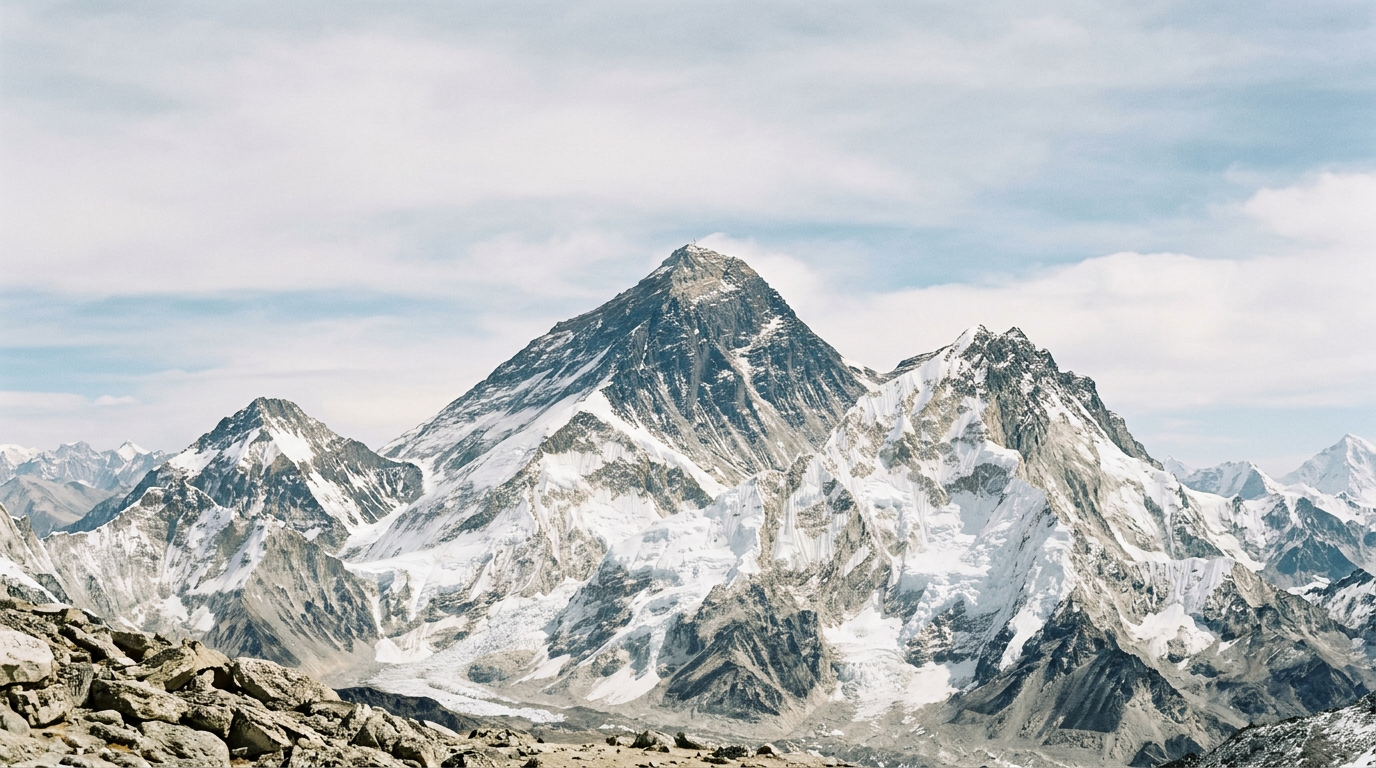
Quick Summary
The summit pyramid of Mount Everest consists of the Qomolangma Formation, a layer of Ordovician limestone formed roughly 450 million years ago at the bottom of the ancient Tethys Ocean. When the Indian tectonic plate slammed into the Eurasian plate around 50 million years ago, the marine sediments lying between them were compressed, folded, and shoved skyward. Over tens of millions of years, that seafloor sediment was hoisted 8,849 metres high.
In a hurry? TL;DR
- 1Everest's peak is made of Ordovician limestone, not volcanic rock
- 2The stone formed in the warm, shallow waters of the ancient Tethys Ocean
- 3Fossilised crinoids, brachiopods, and trilobite fragments sit at 8,849 metres
- 4The collision between the Indian and Eurasian plates buckled the seabed upwards
- 5The range is still rising by roughly four to five millimetres each year
If you stand at the highest point on Earth, you are not balancing on a plug of hardened volcanic magma or a slab of primordial granite. You are standing on lime mud laid down by warm, shallow saltwater.
The summit pyramid of Mount Everest consists of a geological unit known as the Qomolangma Formation. It is a grey-to-yellow limestone packed with the calcified remains of sea creatures: trilobites, crinoids, brachiopods, and conodonts. They lived and died roughly 450 million years ago in a marine basin that no longer exists.
Getting a seabed eight and a half kilometres into the troposphere took one of the most violent, sustained collisions in terrestrial history. It is a slow-motion car crash that began during the age of dinosaurs and has still not finished.
The Vanished Sea of Tethys
Long before the Himalayas existed, the geography of our planet looked unrecognisable. In the early Ordovician Period, nearly half a billion years ago, animal life was exploding across marine ecosystems. Shelled invertebrates thrived in tropical shallows, died, and settled into oceanic silt. Layer upon layer of calcium-rich debris compacted over millions of years, cementing into hard limestone.
By the Mesozoic Era, this limestone formed part of the floor of the Tethys Ocean, an immense body of water wedged between two giant landmasses: Gondwana in the south and Laurasia in the north. If you looked at a map of the Earth 150 million years ago, the slice of crust that now forms the top of Everest sat submerged beneath warm ocean currents.
Then Gondwana broke apart. The fragment of continental crust carrying present-day India detached and began migrating north. It was not a leisurely drift. Geologically speaking, India was sprinting, covering up to 15 to 20 centimetres a year across the Tethys basin.
The Collision That Shoved an Ocean Upwards
Roughly 50 million years ago, the sprint ended. India crashed into the southern belly of the Eurasian landmass. When an oceanic plate collides with a continental plate, the heavier oceanic crust typically dives beneath the lighter continental crust in a process called subduction, sliding down into the mantle to melt.
Here, the dynamics were different. Both India and Eurasia were thick, buoyant slabs of continental crust. Neither was willing to sink into the Earth's mantle. Instead of sliding cleanly underneath, the two masses crumpled together like the bonnets of two lorries hitting head-on.
The oceanic crust and deep sediment of the Tethys Ocean were trapped in the vice between them. Tremendous compressive force sheared off huge packages of sediment, folding them like an accordion and stacking them one on top of the other along gigantic fault systems. This collision zone turned into an enormous orogenic belt, lifting the compressed seabed out of the water and shoving it towards the clouds.
The rock at the summit of Everest was not created during the collision. It was simply the topmost layer of marine strata caught in the squeeze, pushed up and preserved from the deep metamorphism that baked and deformed the rocks beneath it.
How We Know: Rocks in Mallory's Pocket
For centuries, Western science assumed mountains were either extinct volcanoes or wrinkles produced as a cooling Earth contracted like a drying apple. The notion that ocean beds could be thrust nine kilometres upwards sounded preposterous until explorers physically brought the evidence down from the mountain.
During the ill-fated 1924 British Mount Everest expedition, geologist Noel Odell collected rock samples while climbing above 7,900 metres. He noted that the highest strata were sedimentaries, not volcanics. Decades later, micropalaeontologists examining thin sections of summit rock confirmed unequivocal faunal evidence: micro-fossils of marine invertebrates whose bodies could only have formed under water.
Seeing marine fossils resting atop Everest provided some of the most vivid confirmation imaginable for continental drift and plate tectonics, two scientific ideas that began as thoroughly weird before becoming indisputable foundations of Earth science.
The Anatomy of the Peak
Everest is not a uniform block of stone. Climbers tackling the upper reaches cross three distinct geological divisions:
- The Greater Himalayan Sequence: Below roughly 8,500 metres lies high-grade metamorphic rock: gneisses, granites, and schists that were deeply buried, partially melted, and recrystallised by heat and pressure.
- The Yellow Band: Between roughly 8,200 and 8,600 metres sits a pale, yellowish layer of marble and deformed limestone. This is rock that underwent intense heat and shearing as a massive low-angle fault (the South Tibetan Detachment) slipped beneath the summit cap.
- The Qomolangma Formation: From roughly 8,600 metres to the 8,849-metre summit sits the Ordovician limestone. Because it sat on top of the fault rather than below it, it escaped the worst of the deep-crust cooking, leaving its fossilised sea shells intact.
Because the Indian plate continues to push northward into Asia at a rate of roughly four centimetres every year, the entire Himalayan range remains active. The summit still creeps upwards by approximately four to five millimetres each year, balanced against the constant gnawing of glaciation, frost-shattering, and gravity.
How to actually use this
Beyond winning a pub quiz round on mountaineering, this geological oddity provides a useful cognitive model for how the physical world behaves over vast stretches of time.
- Counter-intuitive stability: We instinctively think of high mountain peaks as ancient monoliths and sea floors as fragile basins. In reality, the rocks at the bottom of our oceans are young (rarely older than 200 million years), while the oldest rocks often survive by being hoisted high onto continental landmasses.
- The scale of slow inputs: A collision moving at four centimetres per year sounds imperceptible, yet sustained over 50 million years, it built the largest mountain range on the planet. Small, continuous inputs consistently out-muscle sudden, dramatic forces over deep time.
Related Small Talk reading
- Read our concise breakdown of marine fossils resting atop Everest in the Small Talk fact archive.
- Discover why mountain building is classified under an orogenic belt.
- Explore how historical scientists deciphered ancient faunal evidence to reconstruct prehistoric climates.
- Catch up on today's daily Small Talk or browse more from the Small Talk blog for daily intellectual snacks.
*Get one genuinely interesting idea delivered straight to your brain every morning with the Small Talk app.*
Frequently Asked Questions
Learn something new each day
Daily words, facts and quotes delivered to your phone.
