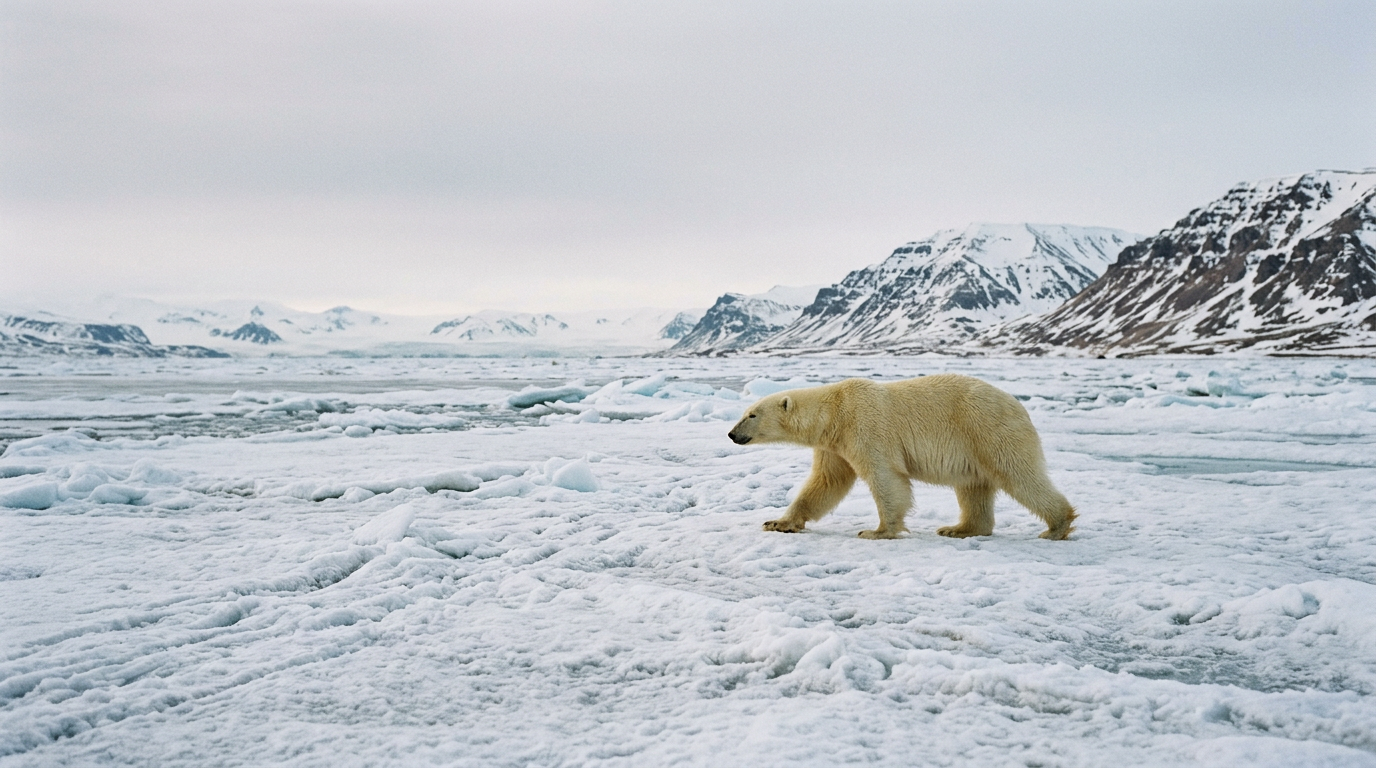
Quick Summary
This week's digest ties together three counterintuitive realities: polar bears rely on clear, hollow hair rather than white pigment to survive the Arctic; southern Britain rests upon trillions of calcified plankton skeletons from a warm Cretaceous sea; and human conversation depends on frequent, minor fibs to maintain social harmony. Reality rarely matches our shorthand descriptions of it, whether we are examining animal fur, geological bedrock, or ordinary dinner-table banter.
In a hurry? TL;DR
- 1Polar bear fur is translucent and hollow, scattering light over jet-black skin.
- 2Britain's chalk cliffs are compressed graveyards of single-celled algae.
- 3Most adults tell several harmless untruths within brief, casual chats.
- 4Turnip lanterns preceded pumpkins across the British Isles by centuries.
- 5Everyday assumptions crumble when examined through physics and deep time.
- 6A working reserve of odd facts makes ordinary conversation far more interesting.
Sunday mornings exist for slow contemplation and better tea. Throughout the past seven days at Small Talk, we examined how easily common sense misleads us, whether we are looking across the ice sheets of Svalbard, staring down at a sheer cliff face in Sussex, or merely nodding politely at a colleague's dreary holiday anecdote.
Our brains crave simple labels. We like white bears, solid white stone, and honest neighbours. Yet when you peel back the surface even slightly, the natural world and our social rituals reveal far stranger machinery.
Here is your debrief on the optical trickery of the Arctic, the ancient corpses beneath our feet, and the small deceptions that stop our friendships from falling apart.
Arctic optics: The bear that is not white
If you ask a child to paint a polar bear, they will reach for zinc white. If you ask an evolutionary biologist, they will tell you that white pigment would be an expensive waste of biological energy. In truth, polar bears carry no white pigment whatsoever.
Each guard hair on Ursus maritimus is a hollow, pigment-free shaft of keratin. The core of the hair contains tiny pockets of air that scatter visible light in every direction, an optical phenomenon known as structural colouration. It is the same reason crushed ice looks white even though water is clear. Beneath that brilliant, light-scattering coat sits thick, leathery, coal-black skin.
This setup is a masterpiece of thermal engineering. The dark skin absorbs heat from solar radiation, while the hollow hairs trap warmed air close to the body and prevent it from escaping into sub-zero winds. If you want to understand the exact mechanics of their fur and skin, we broke down why polar bears aren't actually white earlier this week. The next time someone mentions the blinding white predator of the north, you can gently point out that they are looking at a walking optical illusion.
Deep time underfoot: The plankton cemetery
Shift your gaze from the Arctic Circle to the English Channel. The chalk hills of the North and South Downs, terminating in the dramatic sea cliffs of Dover and Beachy Head, look like monuments of permanence. They are often treated as the geographic emblem of Britain itself: stoic, pale, and immovable.
Yet chalk is not simple rock. It is almost entirely biological debris. Between 100 million and 66 million years ago, during the Late Cretaceous epoch, a warm, shallow sea covered much of northern Europe. In those sunlit waters drifted unfathomable populations of coccolithophores, single-celled marine algae. Each organism encased itself in tiny, overlapping plates of calcium carbonate called coccoliths. When the algae died, their microscopic armour settled onto the sea floor as fine ooze.
Because this process occurred across tens of millions of years in the absence of heavy muddy sediment from nearby landmasses, the ooze accumulated into beds hundreds of metres thick. Tectonic forces eventually pushed those ancient ocean beds above sea level. We published an exploration on how microscopic plankton formed Britain's chalk cliffs, and the scale remains difficult to comprehend. Every crumb of chalk on a school blackboard or sea ledge is a handful of fossilised single-celled skeletons.
The social grease of casual untruths
From geology we turn to psychology, which offers equally humbling realisations. We pride ourselves on personal integrity, yet our everyday conversation is saturated with quiet fabrications.
Psychologist Robert Feldman ran an experiment in which two strangers were filmed having a casual, ten-minute conversation. Before watching the tape back, participants genuinely believed they had been straightforward and candid. Once confronted with their own recorded words, however, roughly sixty percent discovered they had told at least one lie, with the average liar uttering two to three untruths in that short window.
These were not sinister frauds designed to swindle money. They were social splints: exaggerating an agreement about a dull film, feigning enthusiasm for a stranger's dog, or inventing a reason to wrap up a chat. We looked closely at the surprising frequency of casual dishonesty, and the takeaway is oddly reassuring. Casual dishonesty is rarely driven by malice. Instead, it is the social lubricant that keeps casual encounters from curdling into awkward silence. Absolute honesty sounds noble in theory; in a ten-minute lift ride, it would be catastrophic.
Turnips and seasonal continuity
Because we have just crossed from October into November, it is also worth remembering that even our festive traditions rest on practical improvisation. The orange pumpkin grinning from suburban doorsteps is an imported American convenience. For centuries across Ireland and Scotland, Halloween revellers hollowed out rock-hard root vegetables to ward off wandering spirits.
Our Halloween dispatch revisited the folklore behind carving gnarled turnips, tracing how Celtic communities hacked through fibrous rutabagas with small paring knives. An illuminated turnip looks genuinely demonic, far more menacing than the neat, cheerful grin of a pumpkin. It is a useful reminder that folklore evolves along paths of least resistance. When immigrants arrived in North America, they abandoned the stubborn turnip immediately because squash was softer to carve.
How to actually use this
Curiosity is entertaining on a Sunday, but it is far more potent when put to work on a Monday. Here is how to translate this week's miscellany into practical social currency:
- Reflect rather than project. When caught in an awkward lull at work, deploy the polar bear's structural colouration. It bridges science and everyday experience without sounding academic.
- Reframe your surroundings. If you walk across the Downs or look at limestone architecture this week, remind yourself of the Cretaceous ooze. Perspective shrinks modern anxieties.
- Notice your conversational padding. Pay attention to the small lies you tell over the next twenty-four hours. Do not beat yourself up over them; observe which ones you use to protect other people's feelings and which ones you use to protect your own ego.
- Keep your curiosity sharp. Good conversation does not require grand speeches. It relies on a steady appetite for how things work underneath their tidy labels.
Related Small Talk reading
If you missed any of these stories during the week, dive into the full investigations:
- Revisit the optical physics of why polar bears aren't actually white.
- Explore deep time and see how microscopic plankton formed Britain's chalk cliffs.
- Examine your own conversational habits with the surprising frequency of casual dishonesty.
- Start next week with fresh clarity by checking today's daily Small Talk.
Keep your eyes open for the strange machinery behind ordinary things, and enjoy the rest of your Sunday.
Frequently Asked Questions
Learn something new each day
Daily words, facts and quotes delivered to your phone.
