Quick Summary
Uranus was discovered in 1781 because light travels across billions of miles of empty space unobstructed, requiring only polished optics and patient record-keeping. Antarctica remained unseen until 1820 because reaching it demanded surviving the world's most violent seas, moving pack ice, sub-zero gales, and scurvy in wooden sailing ships. Herschel could observe the outer solar system from a calm English garden; Antarctic exploration required overcoming immense physical friction on Earth.
In a hurry? TL;DR
- 1Herschel identified Uranus in 1781 from his back garden in Bath.
- 2Mainland Antarctica was not sighted until 1820 by Russian, British, and American sailors.
- 3Space is transparent to photons, allowing telescopes to pierce billions of miles.
- 4The Southern Ocean is guarded by the Roaring Forties, Screaming Sixties, and impenetrable pack ice.
- 5Georgian optics advanced far faster than maritime survival gear, nutrition, and hull engineering.
- 6Theoretical belief in a southern continent existed for centuries, but physics kept ships away.
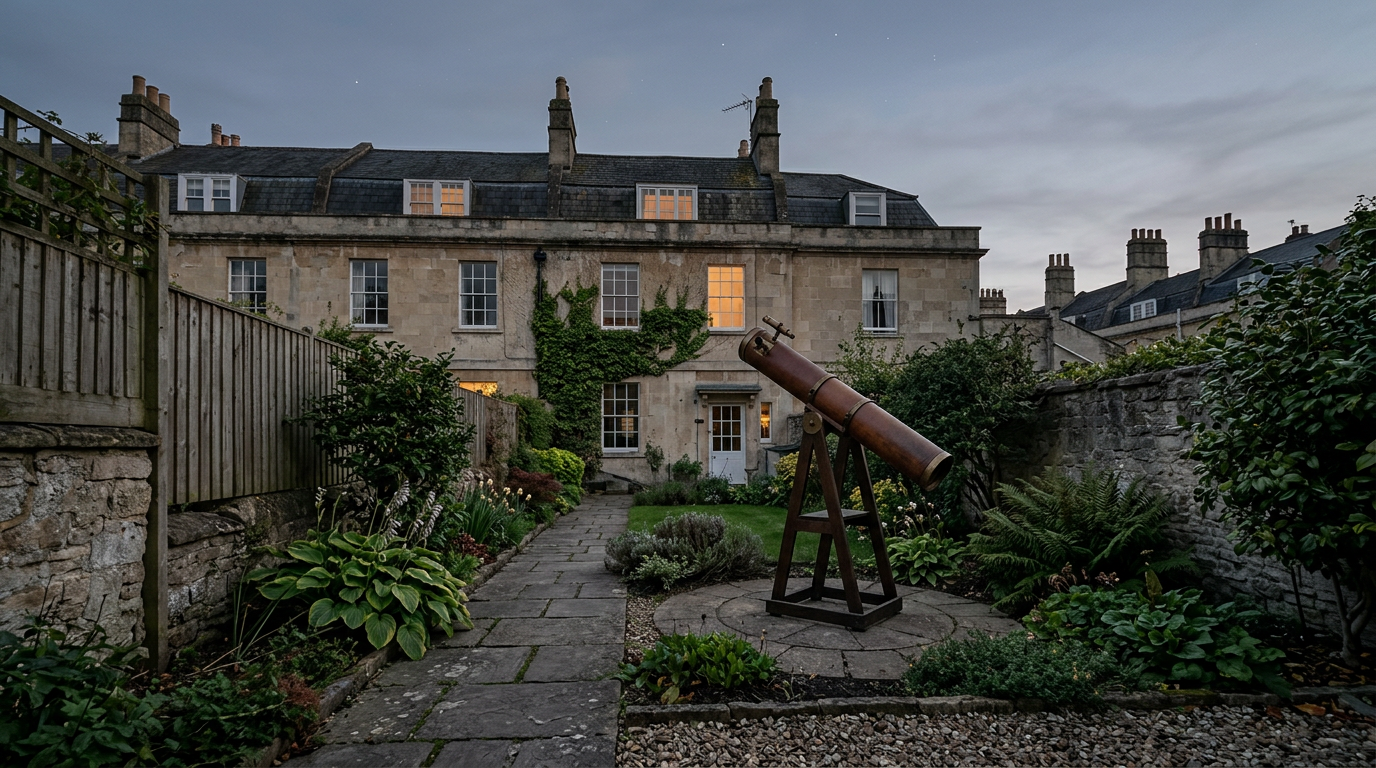
On a crisp Tuesday evening in March 1781, a German-born musician named William Herschel stepped into his back garden on New King Street in Bath. Balancing a home-made, seven-foot reflecting telescope, he focused on a faint speck of light in the constellation Gemini. Within weeks, the astronomical community realised this was not a comet or a faint star, but a gas giant orbiting roughly 1.8 billion miles from the Sun. It was the first planet discovered since antiquity.
Yet on Herschel’s own planet, an entire continent measuring over five million square miles sat completely unrecorded.
Herschel mapped Uranus nearly four decades before sighting Antarctica became a reality for human navigators. While Georgian London discussed planetary dynamics over coffee, no human being had ever set eyes upon the Antarctic mainland. The gap between these two milestones reveals a fundamental truth about discovery: looking into the vacuum of space has always been mechanically easier than fighting the friction of Earth.
The physics of vacuum versus the physics of ice
To discover Uranus, William Herschel did not need to conquer the elements. He needed clear optics, patience, and stable ground. Space is exceptionally generous to light; once a photon reflects off the methane haze of Uranus, it crosses billions of miles of empty vacuum without significant distortion before passing through the Earth's atmosphere.
Herschel had perfected the art of grinding speculum metal mirrors, achieving magnifications that contemporary Royal Society fellows struggled to match. He worked from a terrace garden, went indoors when clouds rolled in, drank hot tea, and retired to bed. His telescope did the heavy lifting because nothing stood between his lens and the planet except air.
Reaching Antarctica, by contrast, required human bodies to wage war against the most hostile climate system on the planet.
Earth's southern latitudes are not merely cold; they are dynamically fortified. Between the 40th and 60th parallels south, the planet has no continuous landmass to interrupt the flow of wind. The result is the Roaring Forties, Furious Fifties, and Screaming Sixties: atmospheric conveyor belts of uninterrupted gales that whip up forty-foot rogue waves. Below those latitudes lies the Antarctic Convergence, where cold polar waters collide with warmer northern seas, creating perpetual fog, ferocious storms, and shifting fields of pack ice capable of crushing a wooden ship like an eggshell.
Cook's invisible barrier
It is not as if humanity lacked interest in the far south. For centuries, cartographers had sketched a hypothetical landmass called Terra Australis Incognita, drawn on maps not out of observation, but from a misplaced conviction of historical precedence and geometric symmetry. Geographers argued that the Northern Hemisphere needed a heavy southern counterpart to prevent the planet from toppling over.
Captain James Cook set out to find it in the early 1770s, less than a decade before Herschel set up his telescope in Bath. Cook was arguably the greatest navigator of his era, equipped with the best ships and the latest chronometers. In January 1773, his vessels Resolution and Adventure became the first ships to cross the Antarctic Circle.
Cook pushed south repeatedly, eventually reaching latitude 71°10' South in 1774. He was, by modern calculations, just seventy-five miles from the Antarctic coast. But he could go no further. Before him lay a solid, towering barrier of pack ice stretching from east to west as far as the crow’s nest could see.
Cook turned back, writing in his journal that this frozen boundary could never be passed, and that if a continent lay beyond, it would remain forever useless and inaccessible. Cook had the navigation skills, but he lacked the metallurgy and steam power required to break through seasonal pack ice. The wooden hulls of the 18th century simply could not survive the collision.
The limits of wooden technology
While astronomers were improving mirrors by fractions of a millimetre, maritime survival remained tethered to ancient constraints.
Consider what voyagers faced when voyaging into hostile frozen waters in the late Georgian era. Ships were constructed of oak and fir, calked with pitch, and driven entirely by canvas sails. If the wind died, you drifted with the ice pack; if the wind blew hard, you risked being driven headlong into an iceberg masked by dense sea fog.
Furthermore, human biology was a fragile cargo. Sailors lived on salted beef, dried biscuits, and grog. While Cook made strides against scurvy with sauerkraut and malt wort, long polar voyages still wore crews down through frostbite, hypothermia, and malnutrition. There were no synthetic waterproof fabrics. A sailor working the rigging at 60 degrees south wore wool and oilskin; once wet, they stayed wet for weeks in unheated quarters.
Herschel required none of this logistics. If his telescope mirror cracked, he cast another in his furnace. If a sailor's hull stove in, hundreds of miles from the nearest port, the entire crew perished without leaving a trace.
The breakthrough of 1820
It was not until 1820—thirty-nine years after the discovery of Uranus—that mainland Antarctica was finally sighted, and even then, three different expeditions laid claim to the moment within weeks of each other.
In January 1820, Fabian Gottlieb von Bellingshausen, commanding a Russian expedition, observed an ice shelf attached to the continental landmass. Days later, Edward Bransfield of the British Royal Navy sighted the Trinity Peninsula, the northernmost tip of mainland Antarctica. Later that year, American seal hunter Nathaniel Palmer caught sight of the same landmass while hunting for fur seal colonies.
Notice the pattern: by 1820, industrial sealing and globalised trade had pushed ships further into the dangerous margins. Navigation had improved, marine charts were more reliable, and national prestige had turned toward polar exploration. Yet, even with these advances, no human actually set foot on the continent until John Davis, another sealer, likely stepped onto the ice in 1821.
How to actually use this
The gap between finding Uranus and sighting Antarctica offers a clean mental model for evaluating modern technology: friction beats distance.
When evaluating difficult problems, do not confuse spatial distance with logistical difficulty. We frequently assume that things further away are naturally harder to explore, but distance is often irrelevant compared to the medium you must travel through.
- Separate optics from physical presence: We can photograph the atmospheric composition of exoplanets dozens of light-years away using the James Webb Space Telescope, yet we have mapped only a quarter of Earth’s ocean floor with high-resolution sonar. Information travels cheaply; physical mass does not.
- Audit your friction points: When managing a project, identify whether your bottlenecks are observational (needing better data) or operational (fighting physical or bureaucratic drag). The latter almost always consumes the bulk of your timeline.
- Beware false comparisons: Just because an organisation can achieve a complex intellectual feat (like deploying an advanced machine learning model) does not mean it can solve simple logistical problems (like moving physical freight on time).
Humanity discovered a celestial giant across two billion miles of open space because we only had to look. We took four more decades to spot our own southernmost continent because we had to survive the journey.
Related Small Talk reading
Explore more unusual intersections of geography, exploration, and physics:
- Read about nearly four decades before sighting Antarctica to see how Herschel's telescope changed observational astronomy.
- Discover why we look to planetary extremes closer to home to understand the slow movement of Earth's crust.
- Learn about the maritime ambition behind voyaging into hostile frozen waters during the 19th-century ice trade.
- Read today's daily Small Talk for your morning dose of sharp historical perspective.
Keep your curiosity sharp. Open the Small Talk app tomorrow morning for another bite-sized dive into the hidden history of the modern world.
Frequently Asked Questions
Learn something new each day
Daily words, facts and quotes delivered to your phone.
