Quick Summary
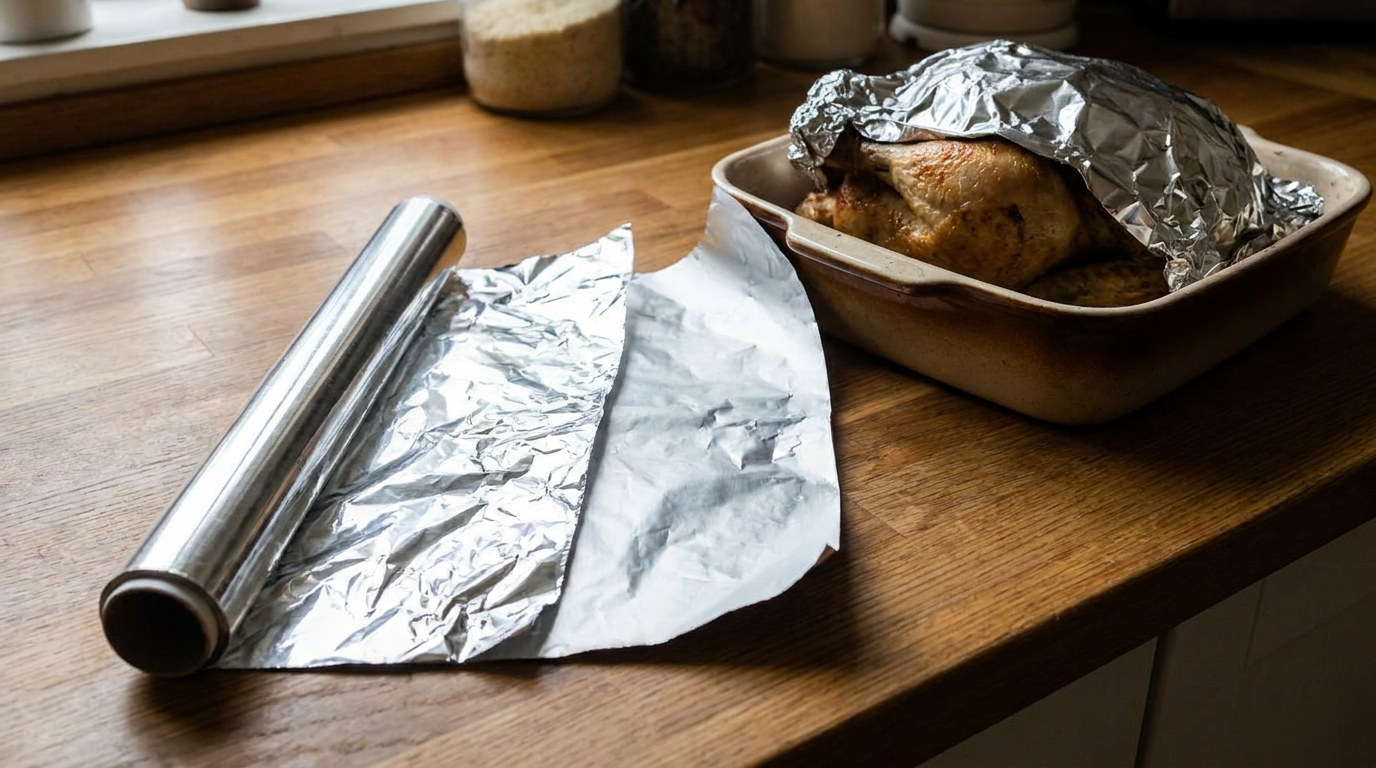
Aluminium foil has a shiny side and a dull side entirely because of an industrial manufacturing method called pack rolling. In the final milling stage, the foil becomes so thin that feeding a single sheet through heavy steel rollers would cause it to tear. Operators therefore feed two layers through at once. The surfaces touching the polished steel rollers emerge gleaming, while the surfaces pressed against each other emerge with a dull, matte texture. Thermally, both sides behave virtually identically.
In a hurry? TL;DR
- 1The two finishes are an accident of industrial manufacturing, not a deliberate cooking design.
- 2Ultra-thin aluminium tears easily if fed solo through high-pressure steel rollers.
- 3Rolling two sheets together—pack rolling—cushions the metal and speeds up production.
- 4The shiny side touched polished steel; the dull side touched another sheet of aluminium.
- 5In domestic ovens, heat reflectance between the two sides differs by a negligible fraction.
- 6The only side that matters in cooking is on specialist non-stick foil, which is clearly labelled.
Walk into almost any domestic kitchen halfway through Sunday lunch preparation, and you will encounter someone nursing a firm, inherited conviction about aluminium foil.
The dogma varies from household to household. One school of thought insists the shiny side must face inward to bounce radiant heat back into the roast chicken. A rival faction claims the dull side absorbs ambient heat more efficiently from the oven air, meaning that facing the reflective surface outwards is an act of culinary sabotage.
Both camps argue their case with absolute certainty. Both are wasting their breath.
The dual finish of kitchen foil was never conceived by food scientists, thermodynamics researchers, or professional bakers. It is an industrial compromise invented over a century ago for a far more mundane reason: to stop high-speed factory machinery from tearing delicate metal into worthless ribbons.
The mechanics of pack rolling
To understand why a roll of Bacofoil looks the way it does, one has to look at the manufacturing process behind aluminium foil. Aluminium does not start out as a gossamer-thin sheet. It begins life as a massive cast ingot weighing up to twenty tonnes, roughly half a metre thick.
Through repeated passes between heated heavy industrial rollers, technicians squeeze the metal down like baker's dough. First comes hot rolling, which reduces the slab to a few millimetres thick so it can be wound into giant coils. Then comes cold rolling, where ambient-temperature rollers apply brutal mechanical compaction to thin the metal down further, hardening its crystalline structure as it flattens.
By the time the metal reaches the final pass, it is approaching its target household thickness: roughly 0.016 millimetres (or 16 microns). For heavy-duty foil, that figure is around 0.024 millimetres.
At these microscopic depths, aluminium becomes remarkably fragile inside a heavy rolling mill. If technicians attempted to run a single ultra-thin web through the final high-pressure steel cylinders, the tension and mechanical drag would cause it to wrinkle, tear, and snap across the line. Shutting down a mill to rethread broken foil is expensive and slow.
Engineers solved this problem with an ingenious technique known as pack rolling. Instead of feeding one sheet through the final roller, they feed two sheets sandwiched directly against one another. Doubling the material provides the tensile strength needed to survive the pass without snapping. It also halves production time.
This sandwich is the sole reason for the two finishes. The outer faces of the sandwich make direct contact with the mill's ground steel rollers, which are polished to a high mirror finish. Under immense pressure, that mirror polish transfers onto the outer aluminium. Meanwhile, the inner surfaces of the sandwich press only against each other. Under microscopic inspection, the friction between the two aluminium webs creates microscopic peaks and troughs that scatter light rather than reflecting it cleanly. When the finished coil is unwound and separated into individual rolls at the end of the line, each sheet carries one glossy side and one matte side.
The physics of domestic ovens
The persistence of the kitchen debate relies on a fundamental misunderstanding of how domestic ovens transfer heat to food. An oven employs three distinct thermal mechanisms: conduction (direct contact), convection (moving hot air), and radiation (infrared waves emitted by the oven walls and heating elements).
In a standard kitchen oven, convection and conduction do the vast majority of the heavy lifting. Radiant heat plays a secondary role unless you are using an overhead grill element.
Proponents of the shiny-side-in theory point out that polished aluminium is an effective radiant barrier. They are technically correct on the basic physics: polished aluminium reflects around 88 percent of radiant infrared energy, whereas the dull side reflects around 80 to 85 percent.
In a domestic kitchen, however, that marginal variance is utterly swamped by everyday cooking conditions. The foil is wrapped directly around meat or vegetables, which means heat conducts straight through the metal regardless of surface gloss. Aluminium has an exceptionally high thermal conductivity of around 237 watts per metre-kelvin. A sheet sixteen microns thick offers virtually zero resistance to conductive heat flow; energy passes through it almost instantaneously.
Testing conducted by commercial test kitchens and food scientists has repeatedly shown that roasting identical cuts of meat with foil shiny-side-in versus shiny-side-out yields temperature variations well within normal measurement error. Over a two-hour roast at 180°C, the orientation makes less than a single degree of practical difference to cooking time or internal temperature.
Why the myth refuses to die
If the thermal difference is functionally non-existent, why does the argument endure? Part of the blame lies with our intuitive association of shiny surfaces with mirrors. A mirror bounces visible light; therefore, our instincts insist, a shiny surface must bounce heat with noticeable culinary consequences.
It does not help that specialised industrial insulation—such as the reflective sarking installed in roof rafters or emergency thermal blankets—does pay careful attention to radiant surfaces. In open air gaps where radiant heat dominates and conduction is minimal, surface emissivity matters immensely. But your Sunday joint of beef wrapped tightly in foil is not a timber attic. Applying building-envelope thermodynamics to a casserole dish is an easy category error to make.
Unless an aluminium sheet is treated with a deliberate chemical coating, the finish remains a purely superficial distinction born out of mechanical expediency.
How to actually use this
In practical culinary terms, you can safely ignore which side faces up for standard roasting, tenting, and baking. There are, however, three useful rules of thumb when working with kitchen foil:
- Watch out for non-stick varieties. The single exception to the rule is specialised non-stick foil. Manufacturers apply a food-grade silicone release coating to only one side of the sheet—invariably the dull, matte side. In these products, packaging explicitly directs cooks to place food against the dull side. If you place food on the shiny side of non-stick foil, it will stick.
- Avoid heavy contact with acids. Aluminium reacts chemically with strong acids and salts. Wrapping cut lemons, tomato-based marinades, or rhubarb directly in foil can pit the metal and deposit microscopic amounts of aluminium salts into your dish. Use baking parchment as an intermediate barrier instead.
- Use the dull side outward for photography. If you are photographing baked goods or recording food preparation, point the dull side toward your camera and lighting. It cuts down on harsh specular highlights without altering how your dish cooks.
Related Small Talk reading
Curious about the unexpected engineering behind everyday objects? Explore our breakdown of the manufacturing process behind aluminium foil, or examine how biology solves its own storage headaches through clever physical packing. You can also discover more about the quirks of language and material science in today's daily Small Talk.
*Keep your curiosity sharp every morning with the Small Talk app, delivering concise, rigorous explanations of the world around you.*
Frequently Asked Questions
Learn something new each day
Daily words, facts and quotes delivered to your phone.
